LH Strips, BBT, Wearable Temp: What Each Measures
An LH strip, a morning thermometer, a ring on your finger, and a blood draw all get lumped together as "hormone tracking." They're not measuring the same thing, or even the same part of your cycle. Here's what each one actually detects.
Quick Answer: What Each Test Measures
An LH strip detects luteinizing hormone in urine, specifically the surge that precedes ovulation by roughly two to three days.[1] Oral BBT and wearable skin temperature don't detect a hormone at all. They detect the temperature rise that progesterone causes after ovulation has already happened.[2]
A lab panel is the only method here that measures hormone levels directly in blood, and it can cover estradiol, progesterone, FSH, AMH, and TSH in one draw.[4] Three different mechanisms, three different windows into the cycle. None of them see the same thing.
Educational content about how these tests work, not medical advice. For questions about which test is right for you, please consult your doctor.
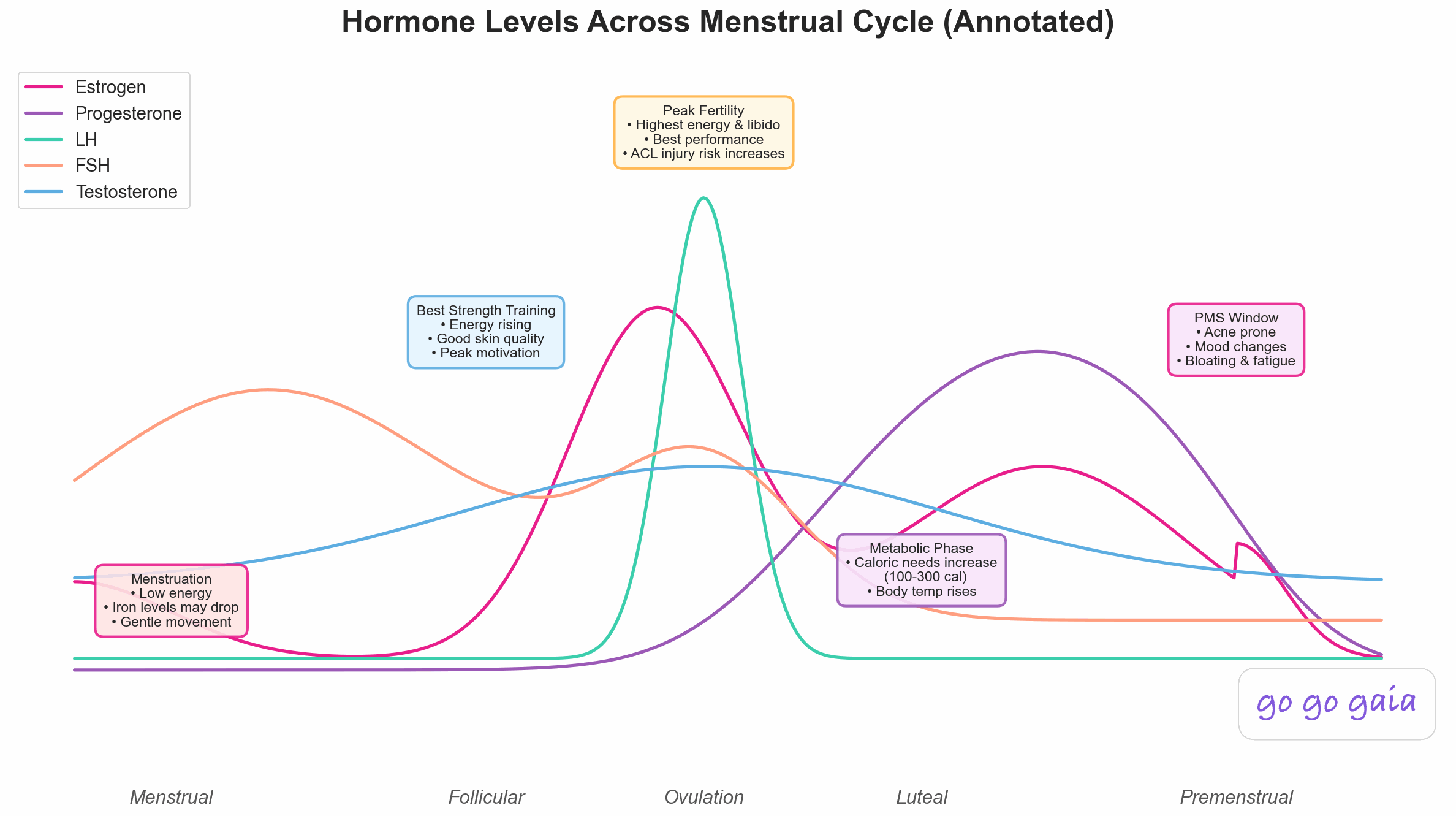
The LH surge (detected by strips) happens before ovulation. The progesterone rise (detected by temperature methods) happens after.
Walk down the fertility aisle and you'll see ovulation strips, basal thermometers, and fertility monitors all sold as roughly the same product: a way to "know your hormones." They're not interchangeable. Each one is reading a different signal, at a different point in your cycle, using a different mechanism.
This page breaks down three categories: urinary LH strips, temperature-based methods (oral BBT and wearable skin temperature), and lab blood panels. We covered the temperature mechanism in detail in how wearables detect your cycle, so this page references that rather than repeating it. The focus here is LH strips and what a lab panel adds that at-home methods can't.
LH Strips: What They Detect and When
Luteinizing hormone (LH) is made by the pituitary gland, and it's present in your urine at low, fairly steady levels for most of your cycle. Roughly a day or two before ovulation, the pituitary releases a sharp, short burst of LH, called the surge, which is the signal that triggers the ovary to release an egg.[1]
An LH strip is an antibody-based test strip. It's built to react once urinary LH crosses a set concentration threshold, which is what produces the second line or color change. Below that threshold, nothing shows. Above it, the strip reads positive. That's the entire mechanism: a threshold reaction to a hormone concentration, not a live gauge of exactly how much LH is present.
Timing Mechanics
The surge itself doesn't equal ovulation. Research on urinary LH immunoreactivity shows the rapid rise in LH usually induces ovulation within about two to three days of the surge starting.[1] That gap is why LH strips are usually described as testing in the days leading up to expected ovulation rather than on a single day.
Because the surge is short, a strip that's read only once a day can miss the peak entirely, catching the rise on the way up or the way down rather than at the top. That's a mechanical limitation of once-daily urine sampling, not a flaw specific to any one brand.
One more mechanical detail worth knowing: what a strip calls "LH" isn't a single clean molecule. Urine contains intact LH along with fragments left over as the hormone breaks down, and researchers have found those fragments stay elevated in urine for several days after the surge itself has passed.[1] Most consumer strips aren't designed to distinguish between intact LH and those breakdown fragments, they're built to react to the surge itself.
Where Temperature Methods Fit
Oral basal body temperature (BBT) and wearable skin temperature work on a completely different mechanism from LH strips, and they answer a different question. Both are reading the temperature rise that progesterone causes once the corpus luteum forms, which only happens after an egg has already been released.[2]
That's the core distinction: an LH strip looks forward to ovulation that hasn't happened yet. Temperature tracking looks backward and confirms ovulation that already happened, usually a day or two earlier.[3] We go through the full mechanics of that, including how wrist and finger sensors sample overnight and build a personal baseline, in how wearables detect your cycle. If you're comparing the two temperature methods specifically, oral BBT is a single morning reading while wearable skin temperature samples continuously overnight, and research comparing the two has found the overnight pattern tracks the same post-ovulation shift.[2]
Put the two together and you get a before-and-after picture: an LH strip flags the days just ahead of ovulation, and a temperature rise confirms it happened a couple of days later. Neither one measures the other's signal.
What Only a Lab Panel Measures
Urine strips and temperature methods are both indirect or single-hormone tools by design. A blood draw is the only method here that measures hormone concentrations directly, and it can cover several hormones from one sample. A standard female hormone panel commonly includes estradiol, progesterone, FSH, AMH, and TSH, sometimes alongside LH, testosterone, and prolactin.[4]
Here's what each of those measures, described plainly and without interpretation:
- Estradiol (E2): The primary form of estrogen produced by the ovaries. It's measured directly from a blood sample and rises and falls across the cycle.
- Progesterone: The hormone produced by the corpus luteum after ovulation. Blood testing measures it directly, unlike temperature tracking, which only measures its downstream effect on body heat.
- FSH (Follicle-Stimulating Hormone): A pituitary hormone that stimulates follicle development in the ovary. It's one of the hormones used, alongside AMH and antral follicle count on ultrasound, in ovarian reserve testing.[4]
- AMH (Anti-Müllerian Hormone): Produced by small follicles in the ovary. It's measured because, unlike FSH, it doesn't fluctuate much across the cycle, so it can be drawn on any day.[4]
- TSH (Thyroid-Stimulating Hormone): A pituitary hormone that regulates thyroid function. It's a standard inclusion in a broader hormone panel as a measure of thyroid activity.[4]
This list describes what each hormone is and how it's measured, not what a given result means for any individual. Reading and interpreting a hormone panel is something to do with a clinician who has your full history, not from a general description like this one. Testing is only one piece of the picture. For the lifestyle factors research actually connects to hormone health, see our guide to balancing your hormones.
Three Mechanisms, Three Windows
Laid out side by side, the differences come down to what's being measured and when in the cycle it shows up.
- LH strip: Urine, threshold-based antibody reaction, detects the pre-ovulation surge, timed roughly two to three days before ovulation.
- Oral BBT / wearable temperature: A physical proxy (heat) for a hormone (progesterone), detected after ovulation, confirming rather than predicting.
- Lab panel: Blood draw, direct hormone measurement, can capture multiple hormones (estradiol, progesterone, FSH, AMH, TSH, and others) in one sample, on a schedule a clinician sets.
None of these methods replace the others, because none of them are measuring the same thing. An LH strip can't tell you your AMH level. A lab panel doesn't give you a daily read the way a strip or a thermometer does. They're different tools built around different mechanisms, not competing versions of the same test.
Logging What You Already Test
Whatever combination of these methods you use, the results are only useful if you can see them next to everything else going on that cycle. A positive LH strip means more when it sits next to your symptoms, sleep, and the temperature reading from the same week, rather than living in a separate app or a paper calendar.
Go Go Gaia lets you log LH test results directly alongside your cycle and symptom data, the same way you'd log a period or a mood entry. It's a logging field, not an interpretation tool: the app records what you tested and when, and lines it up with your other entries so you can see the pattern for yourself.
Frequently Asked Questions
Educational information based on published sources. Not medical advice. For personal concerns, please consult your doctor.
What does an LH strip actually measure?
An LH strip measures luteinizing hormone in urine using an antibody strip that changes color or shows a line when LH crosses a set concentration. It's picking up the surge, a sharp rise in LH that the pituitary gland releases before ovulation. The strip itself doesn't measure estrogen, progesterone, or any other hormone, only LH.
How is an LH strip different from a BBT chart or wearable temperature?
They measure different things at different points in the cycle. An LH strip detects a hormone directly, before ovulation. Oral BBT and wearable skin temperature detect a downstream effect of progesterone, a rise in body temperature after ovulation. LH testing looks forward to an event that hasn't happened yet. Temperature tracking confirms an event that already has.
What hormones do at-home tests miss that a lab panel measures?
At-home strips are built around LH specifically, because LH shows up in usable concentrations in urine. A blood draw measures a wider set of hormones directly, including estradiol, progesterone, FSH, AMH, and TSH. Those require a lab because they're either measured at concentrations urine strips aren't sensitive enough for, or because progesterone in particular isn't reliably measured from urine outside specialized metabolite tests.
Does a positive LH strip mean ovulation is happening right then?
A positive LH strip marks the surge, not ovulation itself. Ovulation usually follows within roughly two to three days of that surge starting, not immediately. The strip is an early-warning signal, not a live readout of ovulation itself.
Can wearable temperature replace an LH strip?
They answer different questions, so one doesn't replace the other. Wearable and BBT temperature tracking confirms ovulation after the fact, once progesterone has already risen. An LH strip is the closer thing to an advance signal, since the surge precedes ovulation by roughly two to three days. Some people use both together: the LH strip for the heads-up, temperature for the after-the-fact confirmation.
Different tests, different windows into the same cycle.
Log an LH result the day you test it and see it sit next to your temperature, symptoms, and mood from the same week, all in one place.
Log Your Next LH TestMost people log their first LH result in under a minute.
References
- Roos J, Johnson S, Weddell S, et al. Quantification of urinary total luteinizing hormone immunoreactivity may improve the prediction of ovulation time. Front Endocrinol. 2022;13:903831. pmc.ncbi.nlm.nih.gov/articles/PMC9581300
- Zhu TY, et al. The Accuracy of Wrist Skin Temperature in Detecting Ovulation Compared to Basal Body Temperature: Prospective Comparative Diagnostic Accuracy Study. JMIR. 2021. ncbi.nlm.nih.gov/pmc/articles/PMC8238491
- Casey FE. Physiology, Ovulation And Basal Body Temperature. StatPearls, NCBI Bookshelf. Updated 2023. ncbi.nlm.nih.gov/books/NBK546686
- Pastore LM, et al. Ovarian Reserve Testing. Endotext, NCBI Bookshelf. ncbi.nlm.nih.gov/books/NBK279058
- National Library of Medicine. Ovulation home test. MedlinePlus Medical Encyclopedia. nlm.nih.gov/medlineplus/ency/article/007062
Related Reading
How Wearables Detect Your Cycle: The Tech Explained
The full mechanics of skin temperature, HRV, and resting heart rate, and why wearable detection always lands after the fact.
How to Tell If You're Ovulating
The signs of ovulation and what temperature, LH tests, and cervical mucus each tell you.
Your Hormone Curve, Explained: Estrogen, Progesterone & LH
How estradiol, progesterone, and LH rise and fall across a typical cycle, phase by phase.
How Accurate Are Period Tracker Apps?
Where calendar predictions come from and why they miss when your cycle changes.