How to Balance Your Hormones: What Actually Helps
You searched "how to balance my hormones" because something feels off: your energy is inconsistent, your cycle feels unpredictable, or your mood swings harder than it used to. This guide covers what research actually says about how sleep, exercise, food, and stress affect your hormones, walks through seed cycling and supplements honestly, and explains when lifestyle changes aren't enough and a doctor conversation is the next step.
Quick Answer: How to Balance Your Hormones
There's no single fix, but a handful of lifestyle factors have real research behind them: consistent sleep, regular exercise (including strength training), steady blood sugar through protein and fiber, stress management, and limiting alcohol and excess caffeine. These support the hormone patterns your body already runs on, they don't override them.
Popular trends like seed cycling are low-risk but not well studied. If your symptoms are persistent, worsening, or don't fit your usual monthly pattern, that's a signal to talk to a doctor, and a tracked symptom log makes that conversation far more useful.
Medical Disclaimer
This article is for educational and informational purposes only and does not constitute medical advice. The information provided is based on general wellness principles and should not replace consultation with qualified healthcare professionals. Always consult your doctor, gynecologist, or healthcare provider before making significant changes to your diet, exercise routine, or lifestyle, especially if you have underlying health conditions, irregular cycles, PCOS, endometriosis, or other medical concerns. If you experience severe menstrual symptoms, please seek medical attention. Individual results may vary, and what works for one person may not work for another.
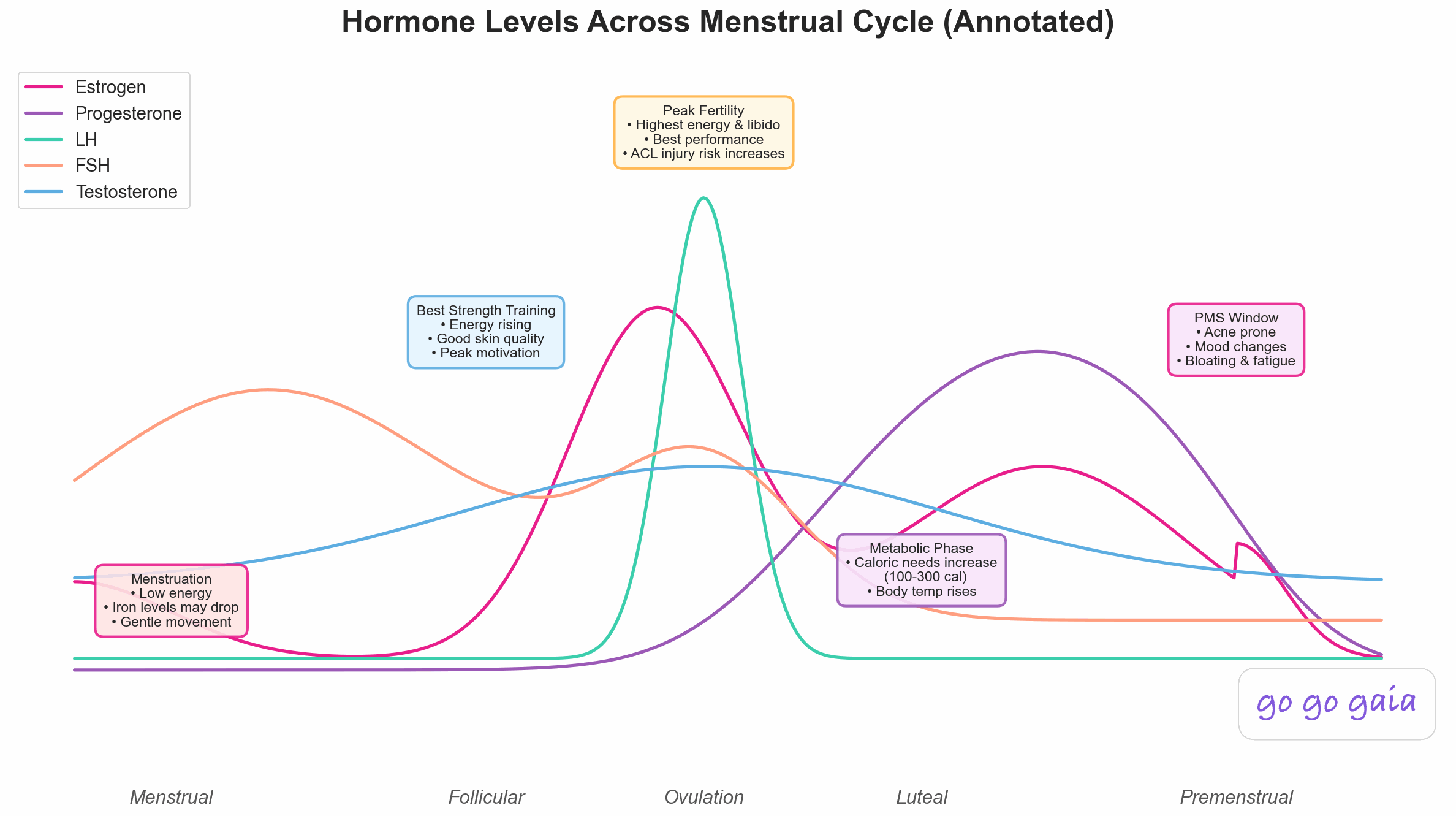
Hormones don't hold still all month, and they aren't supposed to. This is the pattern most of the "balance" advice below is working with.
Your Hormones Aren't Broken, They Cycle
"Hormone imbalance" gets used online to describe almost any symptom, from bloating to bad sleep to a short temper. But your hormones aren't supposed to sit at one steady level all month. Estrogen, progesterone, and LH move through a predictable rise-and-fall pattern by design, and that pattern is what creates your menstrual cycle in the first place.
Estrogen climbs through the first half of your cycle, peaks right before ovulation, and hands off to progesterone for the second half. Progesterone holds the lead for about two weeks, then drops, and that drop is what starts your period. If you want the full mechanism, our hormone curve guide walks through it phase by phase.
A lot of what gets labeled "imbalance" is actually this normal pattern showing up as a symptom: energy that dips in the days before your period, breast tenderness around ovulation, cravings in the week before you bleed. That doesn't mean nothing is ever wrong. It means the starting question isn't "how do I stop my hormones from changing" but "does my pattern make sense, and does it repeat the way it's supposed to."
What Actually Moves the Needle
A handful of lifestyle factors have real research connecting them to hormone health. None of them will override your biology or produce dramatic overnight change. What they can do is support the systems your hormones depend on: sleep, blood sugar, stress response, and metabolism.
Sleep
Sleep and hormone regulation are closely linked. Poor or inconsistent sleep is associated with disruptions to cortisol, insulin, and reproductive hormone patterns, and the relationship runs both ways: hormonal shifts across your cycle can also affect how well you sleep.[4] Keeping a consistent sleep and wake time, even on weekends, is one of the more reliably useful habits for supporting that rhythm.[4]
Exercise, Including Strength Training
Regular physical activity supports insulin sensitivity, mood, and sleep quality, all of which connect back to hormone regulation.[6] Strength training specifically has a reasonable evidence base for supporting metabolic and hormone health in women, alongside its more obvious benefits for muscle and bone.
You don't need to train the same way every day of the month. Matching workout intensity to how you actually feel across your cycle, harder efforts when energy is higher, gentler movement when it's not, is the basic idea behind cycle syncing. Our cycle syncing guide breaks down what that looks like phase by phase, including specific workout types.
Eating Patterns That Support Steady Blood Sugar
Blood sugar swings put stress on the same systems that regulate hormones, since insulin interacts with reproductive and stress hormones.[7] Meals with enough protein and fiber tend to produce steadier blood sugar than meals heavy in refined carbs alone. This isn't a case for a specific diet or eliminating food groups. It's simply that regular, balanced meals may help more than skipping meals or riding sugar spikes and crashes.
Managing Stress
Cortisol, your main stress hormone, doesn't operate in isolation. Chronically elevated cortisol can interfere with reproductive hormone signaling and disrupt normal cycle patterns.[3] You can't eliminate stress, and trying to isn't realistic. Some combination of regular movement, sleep, and downtime that actually feels restful may help blunt its impact on your cycle.
Alcohol and Caffeine
Alcohol affects hormone metabolism, including how the body processes estrogen, and heavier drinking is linked to more cycle disruption.[8] Caffeine in high amounts can affect sleep and, in some people, worsen anxiety or breast tenderness tied to the luteal phase.[9] Neither needs to be eliminated for most people. Paying attention to how your own body responds, especially around your period, is more useful than a blanket rule.
Popular Hormone Trends and What the Evidence Says
Seed Cycling
Seed cycling is a popular recommendation across wellness content: flax and pumpkin seeds in the first half of your cycle, sesame and sunflower seeds in the second half, with the idea that they support estrogen and progesterone at the right times. It's a low-risk practice since all four seeds are nutritious on their own.
The honest evidence picture is thinner than the online enthusiasm suggests. There isn't strong clinical research testing seed cycling as a specific protocol. What evidence exists tends to look at the individual seeds and general nutrition, not the timed-alternation practice itself. If you enjoy it and it fits your routine, there's little downside. Just don't expect it to substitute for medical care if something more significant is going on.
Hormone-Balancing Supplements
Supplements marketed for "hormone balance" cover a wide range, from vitex to inositol to various adaptogens, and the evidence quality varies a lot by supplement and by what symptom it's aimed at. Some have more research behind them for specific uses than others. None are risk-free, and supplements can interact with medications or existing conditions.
Talk to your doctor before starting any supplement, especially if you're on hormonal birth control, trying to conceive, or managing a diagnosed condition like PCOS or a thyroid disorder. "Natural" doesn't mean automatically safe to combine with everything else you're taking.
When It's More Than Lifestyle
Sleep, exercise, and food genuinely help, but they don't treat underlying conditions. Symptoms that trace back to something like PCOS, a thyroid issue, or perimenopause need medical evaluation, not just a better bedtime routine.
There's no specific checklist of thresholds that tells you when to worry. The more useful signal is pattern change: symptoms that are persistent, that are getting worse over time, or that stop fitting the monthly rhythm you're used to. Any of those are reasonable reasons to bring it up with a doctor, even if you're not sure it's "serious enough."
What makes that conversation more productive is data instead of a general impression. Being able to say "this happens every cycle around day 20" or "this has been going on for four months and it's getting worse" gives a doctor something concrete to work from, rather than trying to reconstruct your last few months from memory in a 15-minute appointment.
Step One Is Knowing Your Own Pattern
Before you can tell whether a lifestyle change is working, or whether something is worth a doctor visit, you need to know what your normal actually looks like. That means tracking symptoms against where you are in your cycle, not just noting how you feel on a given day.
A tracking app like Veya can log symptoms, sleep, and mood alongside your cycle day, so patterns like "energy dips are consistent in the week before my period" become visible instead of vague. Over a couple of cycles, you start to see what's a repeating pattern and what's an outlier worth flagging.
If you're curious about testing your hormones directly rather than just tracking symptoms, our guide to at-home hormone tests covers what those tests can and can't tell you, and when they're actually useful.
Frequently Asked Questions
Educational information based on published sources. Not medical advice. For personal concerns, please consult your doctor.
Can you actually balance your hormones naturally?
You can influence some of the lifestyle factors that affect hormone levels, like sleep, exercise, food, and stress, and research shows those factors do matter. But your hormones aren't a dial you can turn to a fixed setting, and they naturally rise and fall across your cycle by design. "Balance" is better thought of as supporting your body's normal patterns rather than reaching a static number. For persistent symptoms, lifestyle changes work best alongside medical care, not instead of it.
What are common signs of a hormone pattern worth investigating?
Cycles that are consistently irregular, very heavy or very light bleeding, persistent fatigue, mood changes that disrupt daily life, unexplained weight changes, or skin and hair changes are all things worth mentioning to a doctor, especially if they're new, worsening, or don't match your usual pattern. On their own, none of these confirm a specific condition. A symptom log that shows when things happen relative to your cycle gives your doctor much more to work with than a memory of "I've felt off lately."
How long before lifestyle changes show up?
It varies by person and by what you change. Some people notice sleep and energy shift within a couple of weeks of a consistent routine. Cycle-related patterns, like PMS symptoms or cycle regularity, usually take at least one to two full cycles to show a clear before-and-after, since a single cycle can be affected by travel, stress, or illness. That's also why clinicians confirming a PMS or PMDD diagnosis rely on prospective daily symptom tracking across at least two consecutive cycles rather than a single one.[10] For exercise specifically, controlled studies have found measurable symptom improvement somewhere in the 8 to 12 week range, so give any change that long before deciding whether it's working.[11][12]
Does seed cycling work?
There isn't strong clinical research testing seed cycling as a specific protocol for hormone balance. It's a popular recommendation online, but the evidence behind it mostly comes from studies on the individual seeds and general nutrition, not from trials of the practice itself. The seeds involved (flax, pumpkin, sesame, sunflower) are nutritious regardless, so trying it is low-risk, but it shouldn't replace care for a suspected hormone condition.
Do I need hormone testing?
Not necessarily, and not as a first step. Hormone levels change throughout the day and across your cycle, so a single blood draw can be hard to interpret without context on timing and symptoms. A doctor will usually start with your symptom history and cycle pattern, then decide if and which tests make sense. Bringing a tracked symptom log to that conversation, whether from an app or a notebook, helps them figure out what's actually worth testing.
Is it normal for hormone symptoms to change month to month?
Yes. Because estrogen, progesterone, and LH shift in a predictable pattern across your cycle, symptoms tied to those hormones, like breast tenderness, mood changes, or energy dips, often show up in the same general window each month rather than at random. That kind of monthly variation is expected. What's worth flagging to a doctor is a change in your usual pattern: symptoms that used to be mild and now aren't, or a rhythm that stops repeating.
References
- Thiyagarajan DK, Basit H, Jeanmonod R. Physiology, Menstrual Cycle. In: StatPearls [Internet]. Treasure Island (FL): StatPearls Publishing; 2026 Jan. ncbi.nlm.nih.gov/books/NBK500020
- Cleveland Clinic. Hormonal Imbalance. my.clevelandclinic.org/health/diseases/22673-hormonal-imbalance
- Cleveland Clinic. Cortisol. my.clevelandclinic.org/health/articles/22187-cortisol
- Mayo Clinic. Sleep tips: 6 steps to better sleep. mayoclinic.org/healthy-lifestyle/adult-health/in-depth/sleep/art-20048379
- ACOG. Premenstrual Syndrome (PMS). acog.org/womens-health/faqs/premenstrual-syndrome
- Mayo Clinic. Exercise: 7 benefits of regular physical activity. mayoclinic.org/healthy-lifestyle/fitness/in-depth/exercise/art-20048389
- National Institute of Diabetes and Digestive and Kidney Diseases (NIDDK). Insulin Resistance & Prediabetes. niddk.nih.gov/health-information/diabetes/overview/what-is-diabetes/insulin-resistance-prediabetes
- National Institute on Alcohol Abuse and Alcoholism (NIAAA). Alcohol's Effects on Health. niaaa.nih.gov/alcohols-effects-health
- Mayo Clinic. Caffeine: How much is too much? mayoclinic.org/healthy-lifestyle/nutrition-and-healthy-eating/in-depth/caffeine/art-20045678
- Miller C, Carlson K. Premenstrual Disorders. In: StatPearls [Internet]. Treasure Island (FL): StatPearls Publishing; 2026 Aug. ncbi.nlm.nih.gov/books/NBK532307
- Mohebbi Dehnavi Z, Jafarnejad F, Sadeghi Goghary S. The effect of 8 weeks aerobic exercise on severity of physical symptoms of premenstrual syndrome: a clinical trial study. BMC Women's Health. 2018;18:80. bmcwomenshealth.biomedcentral.com/articles/10.1186/s12905-018-0565-5
- Philip AE, Singh H, Nanjundiah SY, et al. Impact of Exercise on Perimenopausal Syndrome: A Systematic Review of Randomized Controlled Trials. Cureus. 2025;17(3):e80862. pmc.ncbi.nlm.nih.gov/articles/PMC12008710