How Wearables Detect Your Cycle: The Tech Explained
Your ring or watch never measures a hormone. It reads temperature, heart rate, and breathing, then infers where you are in your cycle. Here's exactly how that works, and why the detection always arrives a step behind.
Quick Answer: How Wearables Track Your Cycle
Wearables detect your cycle from physical signals that hormones move, not from the hormones themselves. The main one is temperature: a ring or watch samples your skin temperature every few minutes overnight, averages it into one nightly value, and learns your personal baseline. After ovulation, progesterone raises your resting temperature by about 0.3 to 0.5 degrees Celsius, and the device flags that sustained rise.[1]
Because progesterone only climbs after the egg is released, this detection is retrospective: it estimates ovulation roughly one to two days after it happened, rather than predicting it in advance. Heart rate variability, resting heart rate, and respiratory rate shift across the cycle too, and devices use them as supporting signals. The sections below break down each one.
Educational content about how the technology works, not medical advice. For personal or fertility concerns, please consult your doctor.
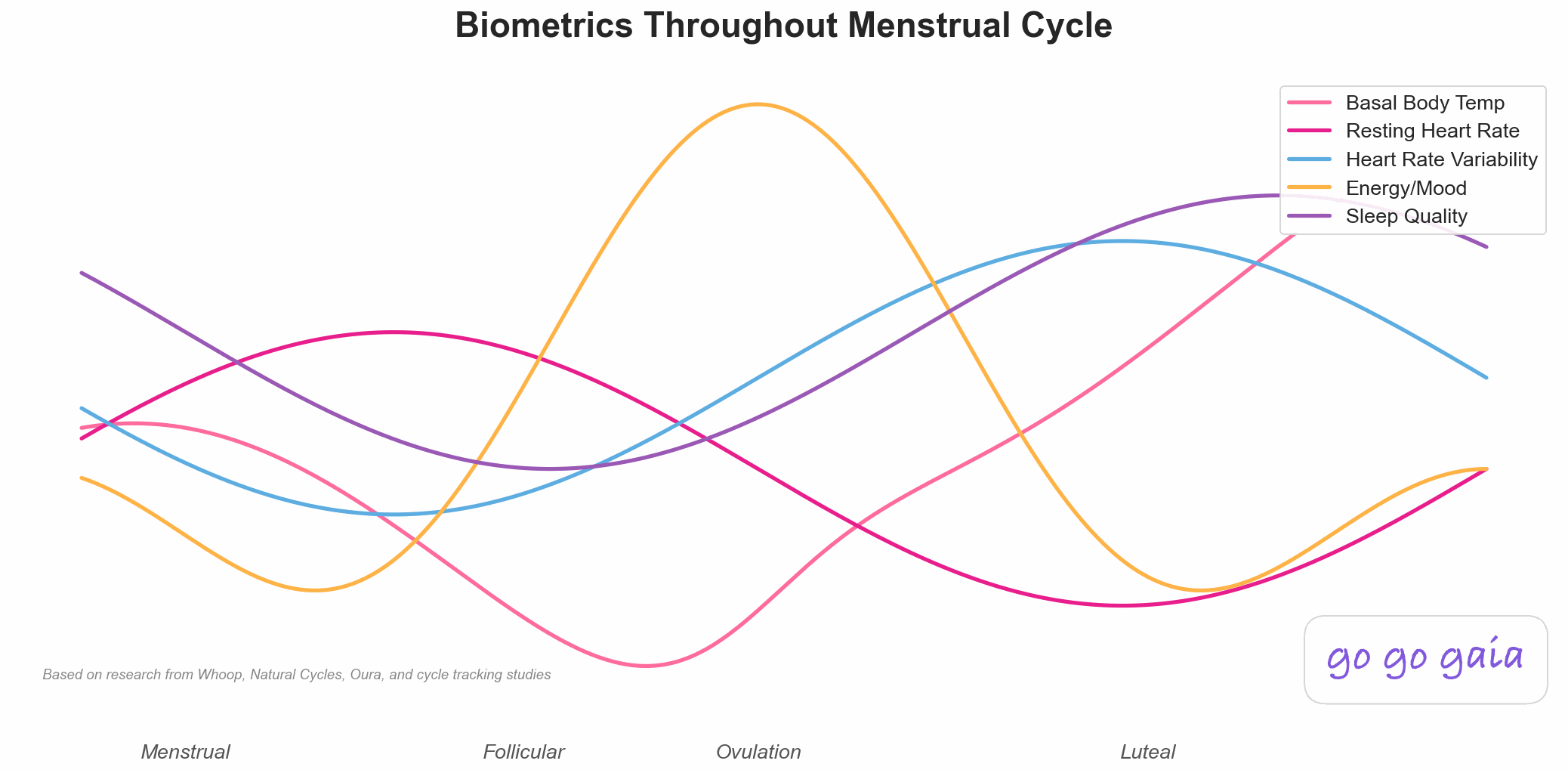
The measurable signals a wearable reads across one cycle. Temperature is the anchor. The rest are supporting evidence.
Open the cycle screen on an Oura Ring, an Apple Watch, or a Whoop and you'll see phases, predictions, and an ovulation estimate. It looks like the device knows your hormones. It doesn't. No consumer wearable measures estrogen, progesterone, or luteinizing hormone.
What it measures is a handful of physical signals that your hormones happen to influence: skin temperature, heart rate, the variation between heartbeats, and how fast you breathe at rest. The cycle features are all built on top of those readings and some math.
This is a companion to our Apple Watch vs Oura vs Garmin comparison, which covers which device to buy and how to train with the data. This page is about the layer underneath: what the sensors actually capture, how the algorithm turns a stream of temperatures into "you ovulated," and why the answer always lands a day or two late.
The Core Idea: Baseline, Then Deviation
Almost every wearable cycle feature runs on the same two-step logic, whatever the marketing name on top.
Step one is the baseline. The device needs to know what normal looks like for you specifically. Your resting temperature, heart rate, and HRV are personal. So over your first week or two of wear, it collects nightly values and builds a rolling personal average. It keeps updating that average as it learns more.
Step two is the deviation. Once it has a baseline, it watches for a departure from it that is big enough and sustained enough to mean something, rather than a one-night blip. A single warm night could be a hot bedroom or a glass of wine. A rise of a few tenths of a degree that holds for several nights in a row is a signal.
This is why a new device asks for patience before it shows you much. It isn't being coy. It genuinely has no idea what your normal is until it has watched you for a couple of weeks. The same baseline-and-deviation model is why one weird night rarely changes your predictions, and why a real shift takes a few days to confirm.
Temperature: The Signal Everything Hangs On
Temperature is the strongest cycle signal a wearable has, because the link to hormones is direct and well documented. Progesterone is thermogenic. It raises your resting body temperature. After ovulation, the corpus luteum starts pumping out progesterone, and your baseline temperature steps up by roughly 0.3 to 0.5 degrees Celsius, then stays up until progesterone falls just before your period.[1]
Plot that over a cycle and you get two distinct levels: a cooler follicular phase and a warmer luteal phase. Clinicians call this the biphasic pattern, and it's the same pattern the old pen-and-paper basal body temperature charts were looking for.
Skin Temperature vs Oral BBT
Here's a distinction that trips people up. Classic BBT is a single reading from an oral thermometer, taken the moment you wake up, before you sit up or talk. Wearables don't do that. They measure skin temperature, continuously, at the wrist (Apple Watch) or the finger (Oura), while you sleep.
Skin temperature is one step removed from core temperature, so the absolute numbers aren't the same as an oral BBT reading. But research on the Oura Ring and on wrist sensors has shown that the overnight skin-temperature pattern tracks the same post-ovulation shift that oral BBT captures.[1][2] The two methods are reading the same underlying event through different windows.
Each approach has a trade-off:
- Oral BBT sits closer to core temperature, but it's a single data point that depends on measuring at the same time every morning, before any movement. Miss the timing and the reading is off.
- Wearable skin temperature samples hundreds of times a night and averages them, which smooths out a single bad reading. But it's more sensitive to your environment: room temperature, blankets, and a warm sleeping partner all nudge skin temperature.
Continuous sampling is the reason a wearable can find your temperature shift even if you'd never manage to take a disciplined 6 a.m. reading by hand.
Why Detection Is Retrospective
This is the single most misunderstood thing about wearable cycle tracking, so it's worth being precise.
The temperature rise a device detects is caused by progesterone. Progesterone only climbs after the corpus luteum forms, and the corpus luteum only forms after the egg is released. So by the time your temperature has risen enough for the algorithm to be sure, ovulation already happened, usually one to two days earlier.[1]
That means a wearable temperature reading confirms ovulation. It does not forecast it. This matters if you're trying to conceive, because the fertile window is the days before ovulation, which the temperature shift has already closed by the time it appears.
Prediction is a separate system. When your app shows a future fertile window, that's not a live hormone reading. It's a statistical forecast built from the timing of your past cycles. The temperature sensor confirms what happened. The calendar model guesses what's next. Two different mechanisms, often shown on the same screen.
Heart Rate Variability (HRV)
HRV is the variation in time between consecutive heartbeats. Your heart doesn't tick like a metronome. The tiny differences from beat to beat reflect the tug-of-war between the two branches of your autonomic nervous system, the sympathetic ("go") and parasympathetic ("rest") sides.
HRV shifts across the cycle. It tends to run higher in the follicular phase and lower in the luteal phase. A set of within-person studies has linked that luteal drop specifically to rising progesterone, which tilts the autonomic balance toward the sympathetic side.[3] In plain terms, the second half of your cycle nudges your body into a slightly more activated state, and HRV registers it.
How the device captures it: HRV is noisy when you're awake and moving, so wearables measure it overnight, usually during stretches of stable deep sleep. That's why your HRV number is a sleep metric, and why a night of bad or short sleep can dent the reading independent of your cycle.
Because HRV responds to stress, travel, alcohol, and illness as much as to hormones, no device leans on it alone to place you in your cycle. It's a supporting signal that lines up with the temperature story.
Resting Heart Rate and Respiratory Rate
Two more overnight signals move with the cycle, and they move for the same underlying reason as temperature.
Resting heart rate (RHR) usually sits at its lowest around menstruation and the early follicular phase, then rises through the luteal phase, often by about 2 to 5 beats per minute above your follicular baseline.[2] The mechanism is the same thermogenic progesterone effect: a warmer core means your heart works a little harder to move blood and shed heat.
Respiratory rate, how many breaths you take per minute at rest, also edges up in the luteal phase. Analysis of overnight wearable data has shown a small but measurable increase after ovulation.[2] Progesterone stimulates the respiratory center in the brain, so you breathe slightly faster.
None of these shifts is dramatic on its own. A couple of extra beats per minute, a fraction of a breath. But stacked together and read against your personal baseline, they form a consistent luteal-phase fingerprint that reinforces what the temperature curve is showing.
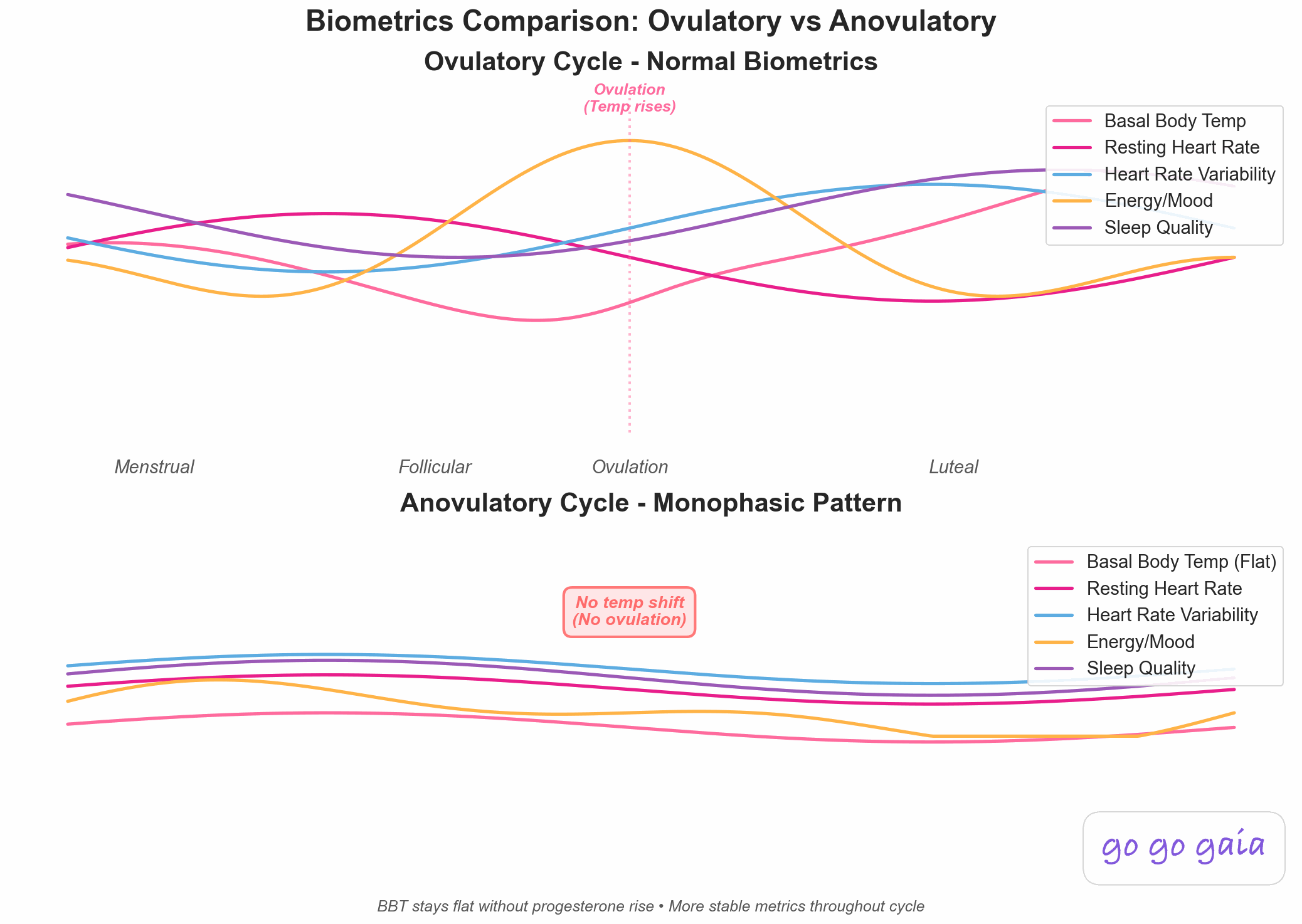
In an ovulatory cycle the signals shift together after ovulation. In an anovulatory cycle they stay flat, because no corpus luteum forms to raise progesterone.
How the Big Three Devices Compute It
The signals are the same across brands. What differs is the sensor placement, the sampling, and what each company is cleared to claim.
Oura Ring
Oura reads temperature from the finger, which sits closer to a stable core reading than the wrist and is less exposed to open air. It samples continuously overnight and reports temperature as a deviation from your own baseline rather than an absolute number, which is exactly the baseline-and-deviation model in action. Oura's period-prediction feature leans heavily on this temperature trend, backed by HRV and resting heart rate. Early validation work on cycle detection was done on Oura's finger-temperature data.[1]
Apple Watch (Series 8 and later)
The Apple Watch added a wrist temperature sensor with Series 8. It samples every few seconds overnight and establishes a baseline over about five nights of sleep wear. If it sees the post-ovulation shift, it shows a retrospective ovulation estimate in the Health app, along with period predictions. Apple is careful with the wording, and so are we: these are informational estimates, not a contraceptive claim. Wrist placement is more exposed to ambient conditions than a finger, which is a known trade-off for accuracy. If you're weighing that free, on-device option against a dedicated app like Flo, see Flo vs Apple Health Cycle Tracking for what each one actually adds.
Natural Cycles
Natural Cycles is a bit different, because it's an app rather than a device, and it's the one FDA-cleared birth-control option in this group. It began with manual morning BBT, then added the ability to pull overnight temperature from an Apple Watch or an Oura Ring. Its algorithm was built and published specifically around detecting ovulation from temperature data.[4] It's the clearest example of temperature-plus-algorithm doing the whole job.
Worth knowing: a device being good at reading temperature does not make it birth control. Only a product specifically cleared for contraception, like Natural Cycles, should ever be used that way. Apple's and Oura's cycle features are informational by design.
What Wearables Can't See
Understanding the mechanism also means being honest about its edges. A wearable is inferring your cycle from physical proxies, so a few things sit outside its reach.
- Actual hormone levels. The device never measures estrogen, progesterone, or LH. It watches their downstream effects. Only a blood panel measures the hormones themselves, and only a urine LH test catches the pre-ovulation surge that predicts (rather than confirms) ovulation. We cover what each method captures in how to tell if you're ovulating.
- Cycles without ovulation. If you don't ovulate in a given cycle, no corpus luteum forms, so progesterone stays low and the temperature curve stays flat. The wearable will simply not find a shift. That flat, monophasic pattern is information in itself, but the device can't explain why.
- The why behind a change. A sensor sees that your temperature is up. It can't tell whether that's ovulation, a fever, a poor night's sleep, or a warm room. Context has to come from somewhere else.
That last gap is where logging what you feel becomes useful. A wearable supplies the objective numbers. Pairing them with your own notes on symptoms, sleep, and mood is what turns a temperature line into something you can actually read. A tracking app like Veya can pull in wearable data from Apple Watch, Oura, or Garmin and line it up against the symptoms you log, so a luteal-phase dip in HRV sits next to the fact that you also slept badly and felt wired. The device measures. The context explains. If your data is also split across a CGM and a folder of lab PDFs, we compared apps that pull all of it together against your cycle phase. That same wearable data also feeds Veya's Health Wrapped, and we break down how each Health Wrapped score is calculated from signals like this one.

The Short Version
Strip away the branded scores and every wearable cycle feature comes down to the same recipe. If passive, wearable-driven tracking is the whole appeal for you, see how that compares to quick-tap logging and full journaling in our breakdown of apps by how much effort they actually require.
- Sample a physical signal overnight, mostly skin temperature, plus HRV, resting heart rate, and respiratory rate.
- Build a personal baseline over a week or two.
- Flag a sustained deviation from that baseline.
- Read the post-ovulation progesterone rise as confirmation that ovulation happened, one to two days after the fact.
No wearable reads your hormones. It reads their shadows and does the math. Once you know that, the numbers on your ring or watch stop being a black box and start being something you can question.
Frequently Asked Questions
Educational information based on published sources. Not medical advice. For personal concerns, please consult your doctor.
How do wearables detect ovulation?
Most wearables detect ovulation from body temperature. They measure your skin temperature every few minutes overnight, average it into a nightly value, and build a personal baseline over one to two weeks. After ovulation, progesterone raises your resting temperature by roughly 0.3 to 0.5 degrees Celsius, and the device flags that sustained rise above your baseline. Because the rise only happens after the corpus luteum starts producing progesterone, wearable detection estimates ovulation a day or two after it occurred rather than predicting it in advance.
What is the difference between skin temperature and basal body temperature?
Basal body temperature (BBT) is a single core-adjacent reading taken with an oral thermometer first thing in the morning before you move. Wearable skin temperature is measured continuously at the wrist or finger while you sleep, then averaged. Skin temperature is a step removed from core temperature, so absolute numbers differ, but research shows the overnight pattern tracks the same biphasic shift BBT does. The wearable trade-off is that continuous sampling can smooth out the noise of a single mistimed morning reading, while skin temperature is more affected by room temperature and bedding.
Does HRV change during your menstrual cycle?
Heart rate variability (HRV), the variation in time between heartbeats, follows a cyclical pattern. It tends to be higher in the follicular phase and lower in the luteal phase. Research links this drop to rising progesterone, which shifts the balance of your autonomic nervous system toward the sympathetic side. Wearables measure HRV overnight when your heart rate is stable, which is why the reading is most reliable during deep sleep.
Why do wearables detect ovulation after it happens instead of predicting it?
The physiology runs backward from prediction. The hormone that raises your body temperature, progesterone, is only produced in meaningful amounts by the corpus luteum, which forms after the egg is released. So the temperature rise a wearable detects is evidence that ovulation already happened, usually one to two days earlier. Devices predict future fertile windows separately, using the statistics of your past cycles, not a live hormone reading.
Can a wearable measure my hormones directly?
No consumer wearable measures estrogen, progesterone, or luteinizing hormone directly. They measure physical proxies that hormones influence: skin temperature, heart rate, HRV, and respiratory rate. The device infers where you are in your cycle from the pattern of those signals. Only a blood panel or a urine LH test measures hormone levels themselves.
Are wearable ovulation estimates reliable enough for birth control?
Wearable cycle features are not birth control unless the specific product is cleared for that use. Apple's Cycle Tracking and Oura's insights are informational. Natural Cycles is the exception: it is an FDA-cleared contraceptive app, and it can pair with an Apple Watch or Oura Ring for temperature input. Reliability depends on consistent overnight wear, and factors like illness, alcohol, and disrupted sleep add noise to the temperature signal.
Your wearable measures the signal. It can't add the context.
A temperature shift means more when it sits next to the sleep, symptoms, and mood you logged that week. Connect your Apple Watch, Oura, or Garmin and see your biometrics against your cycle in one place.
Log One Cycle Alongside Your WearableMost people see their first clear temperature-and-symptom pattern within a single cycle.
References
- Maijala A, Kinnunen H, Koskimäki H, Jämsä T, Kangas M. Nocturnal finger skin temperature in menstrual cycle tracking: ambulatory pilot study using a wearable Oura ring. BMC Womens Health. 2019;19(1):150. doi:10.1186/s12905-019-0844-9
- Goodale BM, Shilaih M, Falco L, Dammeier F, Hamvas G, Leeners B. Wearable Sensors Reveal Menses-Driven Changes in Physiology and Enable Prediction of the Fertile Window. J Med Internet Res. 2019;21(4):e13404. doi:10.2196/13404
- Schmalenberger KM, Eisenlohr-Moul TA, Jarczok MN, et al. Menstrual Cycle Changes in Vagally-Mediated Heart Rate Variability are Associated with Progesterone: Evidence from Two Within-Person Studies. J Clin Med. 2020;9(3):617. doi:10.3390/jcm9030617
- Shilaih M, Goodale BM, Falco L, Kübler F, De Clerck V, Leeners B. Modern fertility awareness methods: wrist wearables capture the changes in temperature associated with the menstrual cycle. Biosci Rep. 2018;38(6):BSR20171279. doi:10.1042/BSR20171279
Related Reading
Apple Watch vs Oura vs Garmin: Which Wins for Cycle Tracking?
Which wearable to pick, and how to train and recover with the data once you have it.
How to Tell If You're Ovulating
The signs of ovulation and what temperature, LH tests, and cervical mucus each tell you.
What Is the Luteal Phase?
The phase after ovulation, where progesterone drives most of the biometric shifts above.
How Accurate Are Period Tracker Apps?
Where calendar predictions come from and why they miss when your cycle changes.
HRV and Resting Heart Rate Across Your Cycle
A deeper dive into the two cardiac signals covered above: how much they typically shift, and why one rough night doesn't mean anything's wrong.
Best App to Track Sleep and Your Cycle
Once your wearable is logging sleep overnight, here's how 5 apps handle pairing that data with your cycle.
Your Hormone Curve, Explained: Estrogen, Progesterone & LH
The estrogen and progesterone mechanics underneath every signal a wearable reads, phase by phase.