Your Hormone Curve, Explained: Estrogen, Progesterone & LH
Every cycle runs on the same three hormones, in the same order, whether you track a thing or not. Estrogen climbs, peaks, and hands off to progesterone. Progesterone holds the lead for two weeks, then drops, and that drop is what starts your next period. Here's the curve, step by step.
Quick Answer: How Your Hormones Move Across a Cycle
Your cycle runs on three hormones moving in a fixed order: estrogen, luteinizing hormone (LH), and progesterone. Estrogen rises through the first half of your cycle as a follicle matures, peaks right before ovulation, and triggers a sharp LH surge that causes the egg to release about a day and a half later.[1][3]
After ovulation, the leftover follicle becomes the corpus luteum and starts producing progesterone, which dominates the next two weeks. Estrogen gets a second, smaller peak around the middle of that phase too. If there's no pregnancy, both hormones drop together, which triggers your period and starts the cycle over.[1][2]
Educational content about typical hormone patterns across a menstrual cycle, based on population-level research. This isn't medical advice, and it isn't a guide to reading your own hormone levels. For personal or fertility concerns, please consult your doctor.
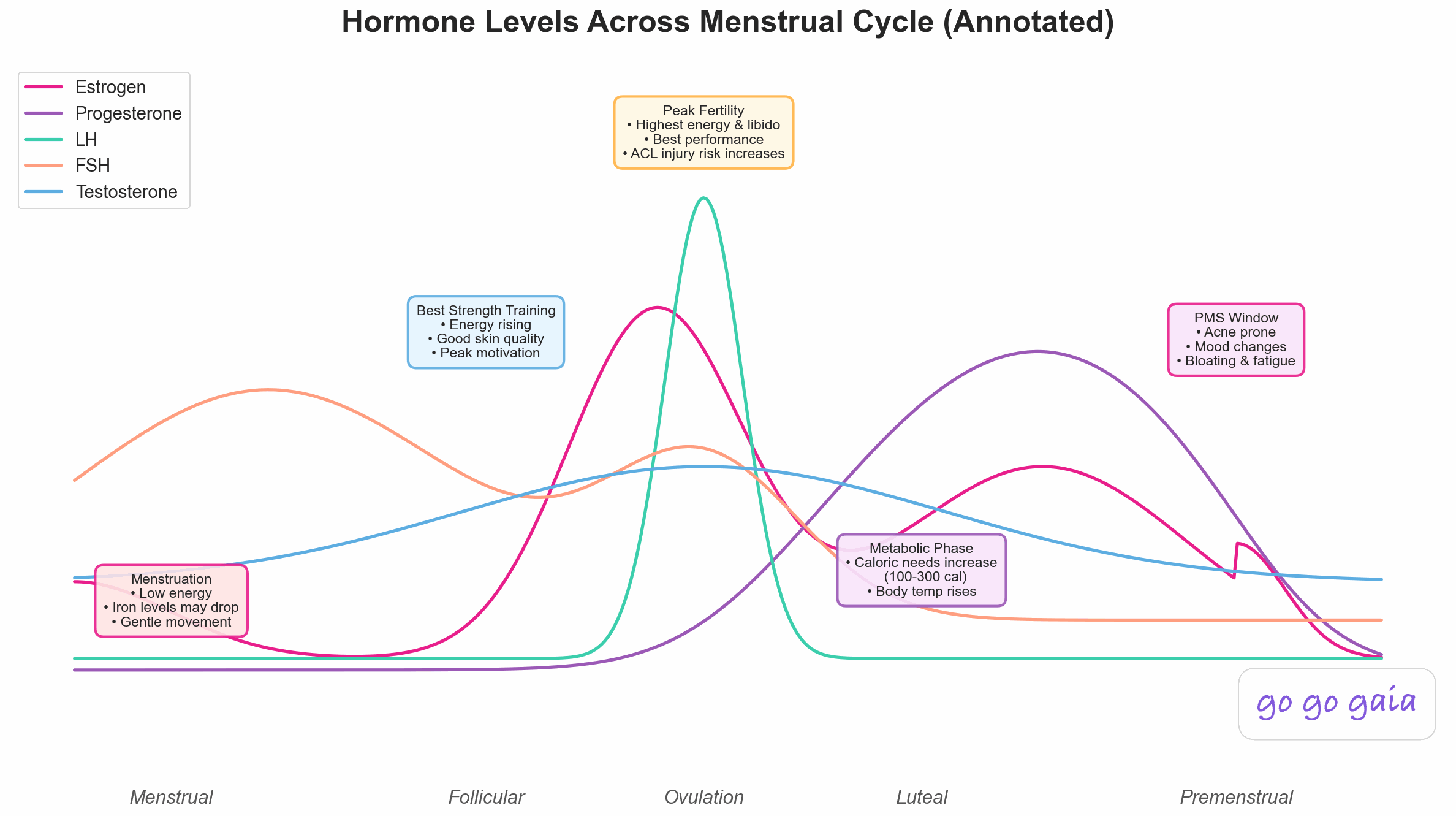
The three-hormone curve across one cycle. Estrogen builds through the first half, LH spikes at ovulation, and progesterone takes over the second half before both drop.
Open any period app and you'll see phase names: menstrual, follicular, ovulation, luteal. Those labels describe what your uterus and ovaries are doing on the outside. Underneath them is a simpler story: three hormones taking turns running the show.
Estrogen, progesterone, and LH follow the same basic shape in most cycles, even though the exact days shift from person to person and month to month. Once you know that shape, phase names stop being arbitrary calendar labels and start making sense as chapters in one hormone story.
This is the reference page for that story. Every other article on this site that explains why a metric, a mood, or a symptom shifts across your cycle points back here for the mechanism underneath it. If you're wondering what to actually do with this pattern day to day, our guide to balancing your hormones covers the lifestyle factors with real evidence behind them.
The Follicular Phase: Estrogen Climbs From a Low Point
Day 1 of your cycle is the first day of your period, and it's also the low point for both estrogen and progesterone.[1] With both hormones down, the pituitary gland releases follicle-stimulating hormone (FSH), which tells a group of follicles in your ovary to start growing.
As those follicles develop, the cells around them start producing estradiol, the main form of estrogen during your reproductive years.[2] One follicle typically pulls ahead of the rest and becomes dominant. It keeps growing, and it keeps producing more estrogen, which is why estrogen climbs steadily through this phase rather than jumping all at once.
By a week or two into your cycle, estrogen has usually risen well above where it started. It isn't done yet. It's building toward the highest point of the entire cycle, which shows up right before ovulation.
Ovulation: Estrogen Peaks, Then LH Surges
For most of the follicular phase, rising estrogen actually holds LH down. That's negative feedback: more estrogen tells the pituitary to ease off LH production. But once estrogen crosses a critical level and stays there for about two days, the feedback flips.[3] High, sustained estrogen suddenly starts pushing LH up instead of down.
That flip triggers the LH surge, a sharp spike in luteinizing hormone that's the direct trigger for ovulation. The surge kicks off roughly a day and a half before the egg actually releases.[1][2] This is also the exact moment estrogen hits its cycle peak, right as LH takes over. That's a different mechanism than what a device like Apple Watch relies on, since Apple Watch estimates ovulation retrospectively from a temperature shift rather than detecting the LH surge itself.
The switch that makes ovulation possible. Estrogen spends two weeks suppressing LH, then flips and triggers it. Researchers call this positive feedback, and it only happens once estrogen holds above a threshold for about 48 hours.[3] It's the single mechanical event that turns "building toward ovulation" into "ovulation happening."
Ovulation itself is quick: the mature follicle ruptures and releases an egg. What's left behind doesn't just disappear. It turns into a new, temporary structure called the corpus luteum, and that structure runs the next two weeks.
The Luteal Phase: Progesterone Takes the Lead
Once the corpus luteum forms, it starts producing progesterone in large amounts, and progesterone becomes the dominant hormone of the luteal phase.[1] It builds quickly after ovulation and usually peaks about a week later, roughly eight to nine days post-ovulation.[2]
Estrogen doesn't disappear during this phase. The corpus luteum produces a meaningful amount of estrogen alongside progesterone, which creates a second, smaller estrogen peak around the middle of the luteal phase.[2] It's nowhere near as high as the pre-ovulation peak, but it's a real second bump, not a flat line.
If there's no pregnancy, the corpus luteum has a built-in lifespan. Around 12 to 14 days after ovulation, it breaks down, and both progesterone and estrogen drop together.[1] That drop is the actual signal that ends the cycle. It releases the pituitary from negative feedback, so FSH starts rising again, and it triggers the uterine lining to shed. Your period starts, and the whole sequence begins again with a fresh cohort of follicles. That same hormone withdrawal is also what drives most premenstrual symptoms — our luteal phase guide covers the day-by-day symptom timeline in more depth.
The Short Version
Four moves, once per cycle:
- Estrogen rises through the follicular phase as a follicle matures.
- Estrogen peaks, then triggers an LH surge that causes ovulation about a day and a half later.
- Progesterone takes over for the luteal phase, with a smaller second estrogen peak alongside it.
- Progesterone and estrogen drop together if there's no pregnancy, which starts your period and the next cycle.
That's the mechanism sitting underneath the phase names on your tracking app, and it's what makes so many other things, like temperature, mood, sleep, and appetite, shift on a schedule instead of at random. Veya logs your cycle day by day and lines it up against whatever else you track, so you can see your own version of this pattern rather than just the general one described here.
See your own pattern next to the general one.
Veya doesn't measure your hormones directly, no consumer app does. What it does is log your cycle day by day and line up your symptoms, mood, and habits against where you are in it, so the shape on this page turns into something specific to you. If your curve is the one that's changing rather than repeating, our perimenopause tracking features cover logging for that.
Track Your CycleFree to start, with your data staying tied to your own logged history.
Frequently Asked Questions
Educational information based on published sources. Not medical advice. For personal concerns, please consult your doctor.
What are the three main hormones in the menstrual cycle?
Estrogen, progesterone, and luteinizing hormone (LH) drive most of the pattern. A fourth hormone, follicle-stimulating hormone (FSH), kicks off follicle growth at the start of each cycle. Estrogen dominates the first half of the cycle, LH triggers ovulation with a short, sharp surge, and progesterone dominates the second half.
What does the hormone curve actually look like across a cycle?
It's not a smooth wave. Estrogen climbs slowly through the first two weeks, spikes to its highest point right before ovulation, drops sharply after the LH surge, then rises again to a smaller second peak in the middle of the luteal phase. Progesterone stays low for the first half of the cycle, then rises fast after ovulation, peaks about a week later, and falls off before your period.
Why does estrogen peak twice in one cycle?
The first peak happens right before ovulation, when a maturing follicle is producing estrogen at its highest rate. The second, smaller peak happens in the middle of the luteal phase, because the corpus luteum, the structure left behind after the egg releases, produces estrogen alongside progesterone. The two peaks behave differently: the first is sharp and drives ovulation, the second is smaller and rides along with rising progesterone.
What actually triggers the LH surge?
Sustained high estrogen does. For most of the follicular phase, estrogen suppresses LH. But once estrogen crosses a critical level and holds there for about two days, it flips from suppressing LH to triggering it, a switch researchers call positive feedback. That flip causes the LH surge, and the surge causes ovulation roughly a day and a half later.
Why does progesterone take over after ovulation?
Because the structure that produces it only exists after ovulation. Once the egg releases, the leftover follicle tissue turns into the corpus luteum, and the corpus luteum's main job is producing progesterone. Without ovulation, there's no corpus luteum, and without a corpus luteum, progesterone stays low. That's why a progesterone rise is a reliable marker that ovulation happened.
What causes the hormone drop that starts your period?
If there's no pregnancy, the corpus luteum survives about 12 to 14 days before it breaks down on its own. When it breaks down, both progesterone and estrogen fall together. That drop triggers the uterine lining to shed, which is your period, and it also releases the pituitary gland to start raising FSH again, kicking off follicle growth for the next cycle.
Does everyone's hormone curve look exactly the same?
The shape is consistent: estrogen rises, peaks, LH surges, progesterone takes over, both drop. The exact timing varies by person and by cycle. Follicular phase length is the most variable part, which is why total cycle length differs between people even when the luteal phase itself stays fairly consistent. This page describes the general pattern, not a fixed schedule.
References
- Thiyagarajan DK, Basit H, Jeanmonod R. Physiology, Menstrual Cycle. In: StatPearls [Internet]. Treasure Island (FL): StatPearls Publishing; 2026 Jan. Updated September 27, 2024. ncbi.nlm.nih.gov/books/NBK500020
- Reed BG, Carr BR. The Normal Menstrual Cycle and the Control of Ovulation. In: Feingold KR, Anawalt B, Blackman MR, et al., editors. Endotext [Internet]. South Dartmouth (MA): MDText.com, Inc.; 2000-. ncbi.nlm.nih.gov/books/NBK279054
- Holesh JE, Bass AN, Lord M. Physiology, Ovulation. In: StatPearls [Internet]. Treasure Island (FL): StatPearls Publishing; 2026 Jan. ncbi.nlm.nih.gov/books/NBK441996
Related Reading
What Is the Luteal Phase?
A closer look at the progesterone-dominant back half of the curve, and why it's when most PMS symptoms show up.
How to Tell If You're Ovulating
How the LH surge described above shows up on ovulation test strips, temperature charts, and cervical mucus.
How Wearables Detect Your Cycle: The Tech Explained
How a ring or watch infers this hormone curve from temperature, heart rate, and HRV instead of measuring it directly.
How Your Resting Heart Rate and HRV Shift Across Your Cycle
The progesterone rise on this page is the reason HRV tends to dip and resting heart rate tends to climb in the luteal phase.
Why Your Blood Sugar Isn't the Same All Month
How the same luteal-phase progesterone rise described above affects insulin sensitivity.