Apple Watch Ovulation Estimates: How They Work
Apple Watch doesn't tell you when you're about to ovulate. It tells you, a few days later, that you probably already did. Here's how the wrist temperature sensor gets there, what setup it needs, and where the native Cycle Tracking layer stops.
Quick Answer: How Apple Watch Estimates Ovulation
Apple Watch Series 8 or later, and every Apple Watch Ultra model, has two wrist temperature sensors that sample continuously overnight.[1] Worn to sleep consistently, the watch builds a personal nightly baseline and watches for the biphasic shift, a sustained temperature rise that follows ovulation. When it detects that shift, it places a retrospective ovulation estimate on your fertile window in the Health app.[2]
The estimate is retrospective by design: progesterone, the hormone behind the temperature rise, only climbs after the egg is already released, so the watch can only confirm ovulation after it happened, not forecast it. Apple asks for consistent sleep wear across at least 2 full cycles before it will surface an estimate, and states clearly that Cycle Tracking is not intended for use as birth control.[3]
Educational content about how the technology works, not medical advice. For personal or fertility concerns, please consult your doctor. Go Go Gaia is not affiliated with Apple Inc.
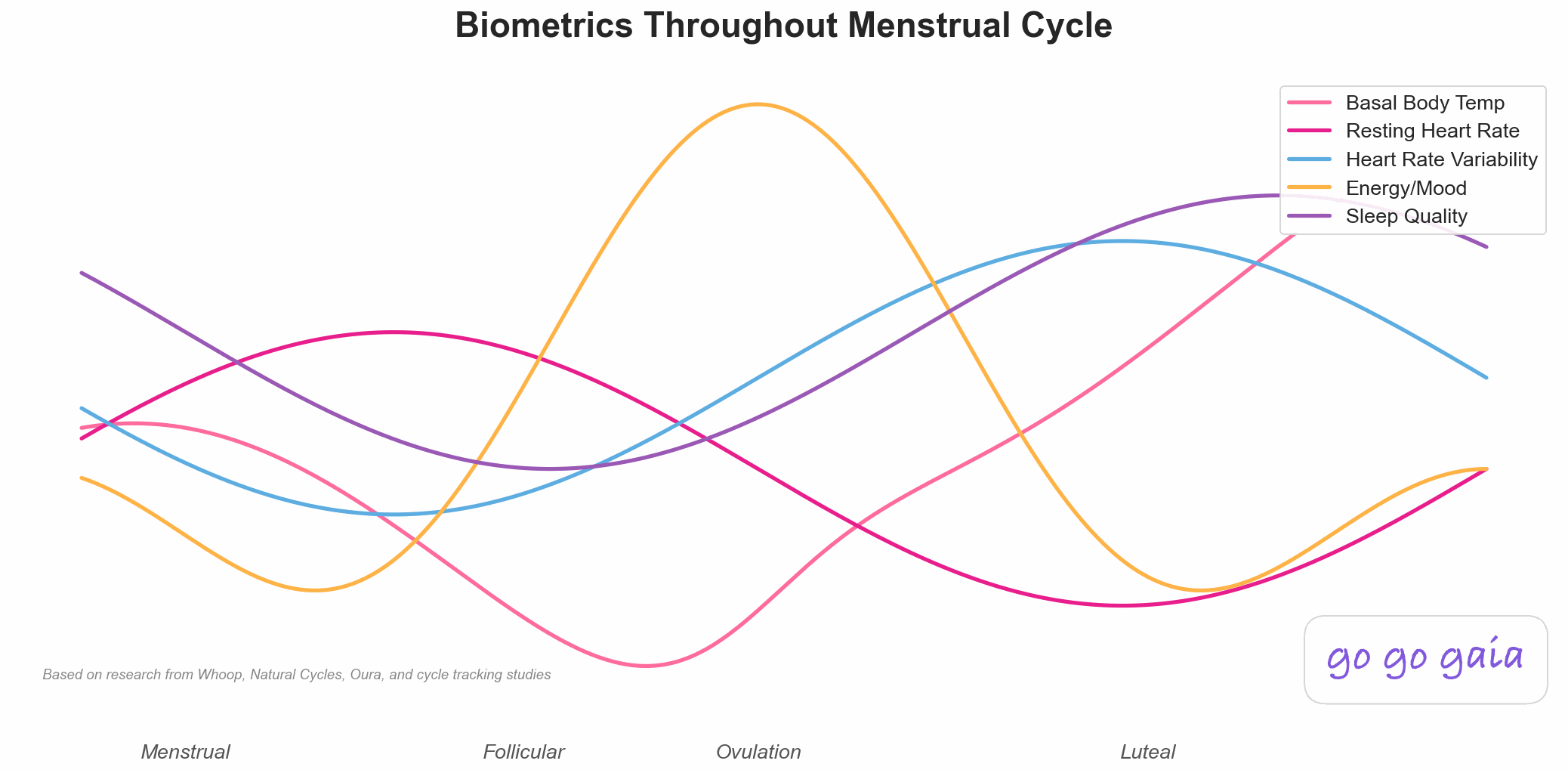
The biphasic temperature shift Apple Watch's wrist sensors are built to detect, always a step behind the event itself.
A few days after ovulation, some Apple Watch owners see a small purple oval appear on their fertile window in the Health app. It's easy to read that as a live prediction. It isn't. It's a retrospective estimate, built entirely from wrist temperature data collected while you were asleep, and it's telling you about something that already happened.
This page walks through the mechanism behind that estimate: the sensor, the setup requirements, and the native Cycle Tracking layer it plugs into. For the broader picture of how temperature-based detection works across brands, see our explainer on how wearables detect your cycle. And if you're weighing Apple's free, on-device option against a dedicated tracking app, our Flo vs Apple Health comparison covers what each one adds beyond what's described here.
The Sensor: Two Thermometers at the Wrist
Series 8 was the first Apple Watch with a temperature sensor, and it shipped with two of them rather than one.[1] Apple has said the second sensor exists to help separate your actual skin temperature from noise introduced by the surrounding environment, since a wrist sensor is more exposed to room temperature, bedding, and airflow than a finger sensor tucked inside a ring.
The watch samples temperature every few seconds overnight while you sleep, and averages those readings into one nightly value.[2] That's the same baseline-and-deviation approach behind every wearable cycle feature: collect nightly data, learn what's normal for you, then watch for a departure from it that's big enough and sustained enough to mean something.
What It Takes to Get an Estimate
Apple is specific about the setup required before the watch will surface a retrospective ovulation estimate. According to Apple's own support documentation, you need:[3]
- Cycle Tracking set up with fertility predictions turned on, and no ongoing cycle factors logged that would interfere with detection (like hormonal birth control, which suppresses the natural temperature pattern).
- Sleep tracking enabled, specifically Track Sleep with Apple Watch, with Sleep Focus active for at least 4 hours a night.
- At least 5 nights of that sleep wear to get usable wrist temperature data for a given stretch.
- Roughly 2 full cycles of consistent overnight wear before the algorithm has enough baseline data to generate its first estimate.
That 2-cycle runway is the same baseline-building logic every temperature-based system needs. The watch has no idea what your normal wrist temperature looks like until it's watched you sleep, consistently, for a while. Skip nights here and there and the baseline takes longer to settle, or an estimate simply doesn't appear for that cycle.
Why the Estimate Always Arrives After the Fact
This is the part that trips people up most. The temperature rise Apple Watch is looking for is caused by progesterone, and progesterone only rises in meaningful amounts once the corpus luteum forms, which happens after the egg is released.[2] So the watch can only confirm that ovulation happened once the temperature has climbed and held for several nights, usually a day or two after the fact.
In the Health app, that shows up as a light purple oval placed retroactively on your fertile window, alongside a note that it's an estimate, not a certainty.[2] Apple's own language is careful here: an ovulation estimate doesn't guarantee ovulation occurred on that exact day, only that the data made it the most likely day given the pattern the watch saw.
Not for Contraception
Apple states this plainly in its Cycle Tracking instructions for use: the feature, including retrospective ovulation estimates, is not intended to be used as a form of birth control.[3] That's worth repeating rather than glossing over, since a fertile-window estimate can look precise enough to lean on.
Natural Cycles is a separate product built for that purpose. It's an FDA-cleared contraceptive app that can pull temperature data from an Apple Watch as one of its inputs, but it runs its own validated algorithm on top of that data.[4] Apple's native Cycle Tracking experience was never built or cleared to do that job on its own.
Worth knowing: Apple's own disclaimer applies whether the goal is avoiding or planning a pregnancy. It's informational either way, not a cleared method for either use.
What Native Cycle Tracking Does and Doesn't Do
It's easy to conflate "Apple Watch has a temperature sensor" with "Apple Watch has full cycle tracking." The native Cycle Tracking layer, synced between Apple Watch and the Health app on iPhone, covers a specific set of things:
- Does: lets you log period start and end dates and cycle factors, shows calendar-based period and fertile-window predictions built from your logged history, and, on supported hardware, adds the retrospective ovulation estimate covered above.
- Doesn't: correlate symptoms with mood, sleep, or nutrition. Track anything outside of the cycle and temperature signal itself. Offer the kind of cross-metric pattern-finding that a dedicated tracking app is built around.
That gap is where a logging app still earns its place next to a watch that's already doing the temperature math. A tracking app like Go Go Gaia can pull in Apple Watch data alongside the symptoms and mood you log by hand, so a wrist temperature shift sits next to the fact that you also logged cramps or low energy that week, something the native Health app view doesn't connect on its own.
The Short Version
- Series 8 and later, and all Ultra models, sample wrist temperature every few seconds overnight through two sensors.
- The watch needs roughly 2 cycles of consistent sleep wear to build a personal baseline before it can generate an estimate.
- Detection is retrospective: the temperature rise confirms ovulation already happened, usually a day or two earlier, rather than predicting it.
- Apple states clearly that Cycle Tracking is not intended for use as birth control. Natural Cycles is the separate, cleared product for that purpose.
- Native Cycle Tracking covers logging, predictions, and the temperature estimate. It doesn't correlate symptoms, mood, or nutrition the way a dedicated app does.
Frequently Asked Questions
Educational information based on published sources. Not medical advice. For personal concerns, please consult your doctor.
Can Apple Watch predict ovulation in advance?
Apple Watch estimates ovulation retrospectively, meaning it identifies the likely day ovulation already happened, not a day in the future. The wrist temperature rise that the algorithm looks for is caused by progesterone, which only rises after the egg is released, so the estimate always arrives after the fact, usually appearing a few days later in the Health app.
Which Apple Watch models support ovulation estimates?
Retrospective ovulation estimates require Apple Watch Series 8 or later, or any Apple Watch Ultra model, because these are the watches with a wrist temperature sensor. Earlier Apple Watch models can still use Cycle Tracking for logging and calendar-based period predictions, but they can't generate a temperature-based ovulation estimate.
Why does Apple Watch need 2 cycles before it gives an ovulation estimate?
The watch needs to build a personal wrist-temperature baseline before it can reliably detect a deviation from it. Apple recommends wearing the watch to sleep for at least 2 full cycles, with Sleep Focus and Track Sleep with Apple Watch enabled for at least 4 hours a night across at least 5 nights, so the algorithm has enough nightly data to separate a real hormonal shift from normal night-to-night noise.
Is Apple Watch cycle tracking a form of birth control?
Apple states plainly that Cycle Tracking, including retrospective ovulation estimates, is not intended to be used as a form of birth control. The feature is informational. Natural Cycles is a separate, FDA-cleared contraceptive app that can pull temperature data from an Apple Watch, but Apple's own Cycle Tracking experience is not cleared for that use.
What does Apple's native Cycle Tracking actually do?
Cycle Tracking lets you log period dates and cycle factors, shows calendar-based period and fertile-window predictions, and, on Series 8 or later and Ultra models, adds a retrospective ovulation estimate from wrist temperature. It syncs with the Health app on iPhone. It does not do symptom correlation, mood tracking, or nutrition logging, which is a different layer than a dedicated tracking app provides.
Why is my Apple Watch ovulation estimate missing some cycles?
An estimate only appears when the watch detects a clear, sustained wrist temperature rise during a cycle where you met the wear requirements. Skipping sleep wear, an anovulatory cycle with no temperature shift to detect, illness, alcohol, or a disrupted sleep schedule can all mean no estimate shows up for that particular cycle. That's expected behavior, not a malfunction.
A retrospective estimate is a data point, not the whole story.
Apple Watch confirms a temperature shift after it happens. It won't tell you what else was going on that week. Sync your data and log symptoms and mood alongside it to see the fuller picture.
Log One Cycle Alongside Your Apple WatchMost people see their first clear pattern within a single cycle of logging.
References
- Apple Inc. Findings from Apple Women's Health Study advance science around menstrual cycles. Apple Newsroom, March 2023. apple.com/newsroom
- Apple Inc. Receive retrospective ovulation estimates on Apple Watch. Apple Support. support.apple.com/en-us/120357
- Apple Inc. Cycle Tracking Instructions for Use. apple.com/legal/ifu/cycle-tracking
- Shilaih M, Goodale BM, Falco L, Kübler F, De Clerck V, Leeners B. Modern fertility awareness methods: wrist wearables capture the changes in temperature associated with the menstrual cycle. Biosci Rep. 2018;38(6):BSR20171279. doi:10.1042/BSR20171279
Related Reading
Flo vs Apple Health Cycle Tracking: What You Give Up
What Apple's free, native cycle tracking covers, and what a dedicated app like Flo adds on top.
How Wearables Detect Your Cycle: The Tech Explained
The full mechanism across Oura, Apple Watch, and Natural Cycles: baseline, deviation, and why detection is always a step behind.
Oura Cycle Insights & Readiness: What They Measure
The same temperature-deviation idea, built into a finger sensor instead of a wrist sensor.
Oura vs Apple Watch for Cycle Tracking (2026)
Wrist sensor vs finger sensor head-to-head, plus how Natural Cycles fits into either one.
How to Tell If You're Ovulating
The signs of ovulation and what temperature, LH tests, and cervical mucus each tell you.