Oura Cycle Insights & Readiness: What They Measure
Cycle Insights and the Readiness Score look like two separate features on your Oura app, but they're built from a lot of the same raw signal. Here's what each one actually reads, how the math works, and where the estimates run out.
Quick Answer: How Oura's Cycle and Readiness Scores Work
Cycle Insights is built on finger temperature. Oura's ring samples your skin temperature continuously overnight, averages it, and reports it as a deviation from your own baseline rather than an absolute reading.[1] After ovulation, that average temperature climbs and stays up, and Oura uses the sustained rise to mark a likely cycle phase shift, refine period predictions, and flag a fertile window.
Readiness is a separate, broader daily score. It combines temperature with sleep, HRV Balance, Activity Balance, and Recovery Index.[2] Temperature is unusual among Readiness contributors: it can only pull the score down when it's abnormal, never push it up.[3] Neither score reads a hormone directly. Both are inferences from physical signals.
Educational content about how the technology works, not medical advice. For personal or fertility concerns, please consult your doctor. Go Go Gaia is not affiliated with Oura Health Oy.
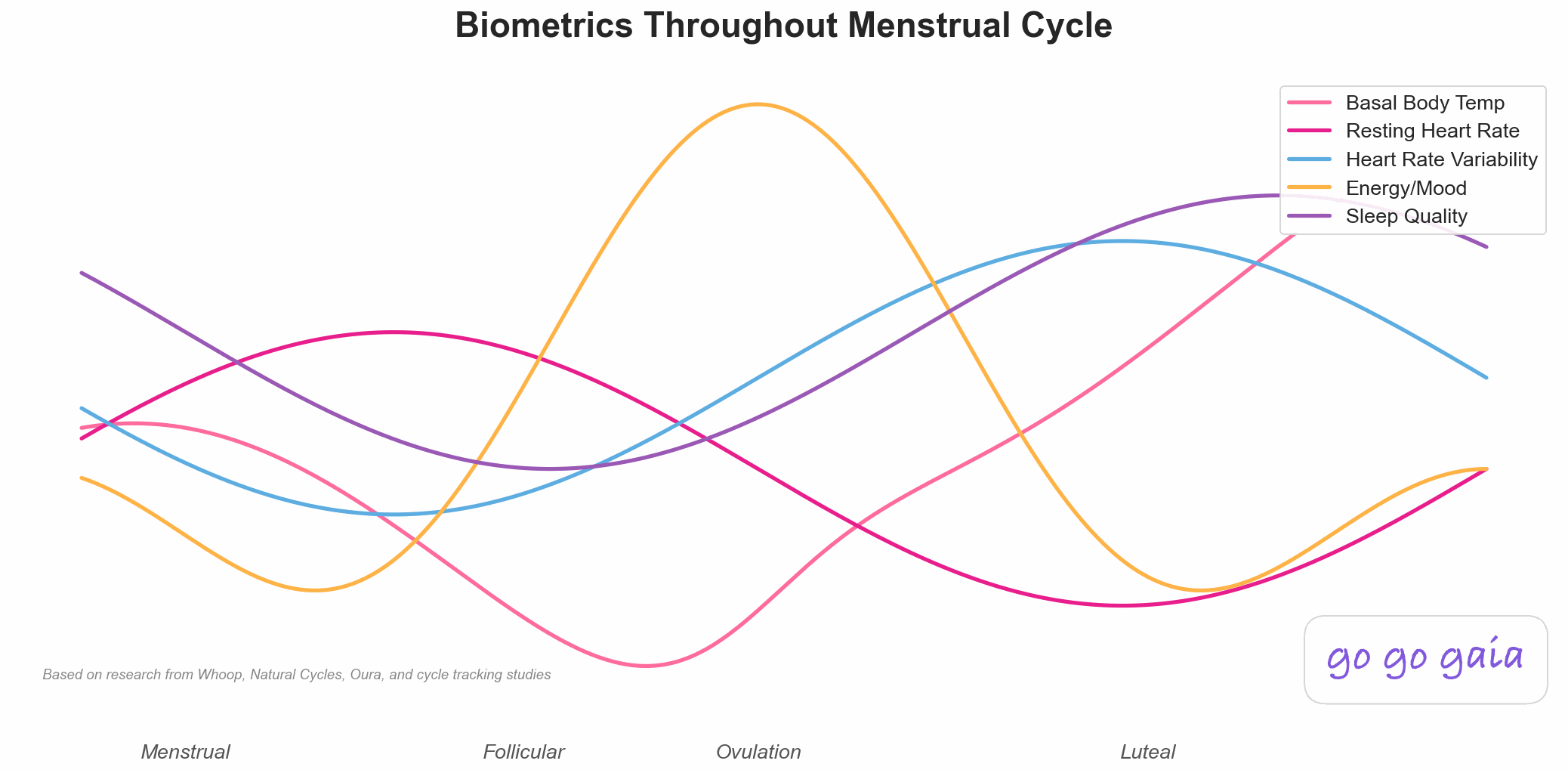
The same baseline-and-deviation signal underlies both Cycle Insights and the temperature contributor in Readiness.
Open the Oura app during your luteal phase and you'll usually see two things pointing the same direction: a cycle insight noting a temperature shift, and a Readiness Score that's a few points lower than usual. It can look like the ring "knows" you're mid-cycle and adjusts your recovery number for it. What's actually happening is narrower and worth understanding, especially if you're trying to decide how much weight to put on either number.
This page is a companion to our broader explainer on how wearables detect your cycle, which covers the same baseline-and-deviation mechanism across Oura, Apple Watch, and Natural Cycles. This one goes deeper on Oura specifically: what Cycle Insights measures, how Readiness is built, and where the two overlap and diverge.
The Sensor: Finger Temperature, Not Core Temperature
Oura's temperature sensor sits at the finger, inside the ring, which places it closer to a stable reading than a wrist-worn sensor exposed to open air.[1] It samples continuously while you sleep and rolls that into one nightly average.
Oura doesn't report that average as a raw number in the app. It reports it as a deviation: how far tonight's average sits from your personal baseline.[4] The company calculates that baseline during your first couple of weeks of wear, then keeps adjusting it as it collects more nights. That's the same baseline-and-deviation logic every temperature-based cycle feature runs on, whatever brand is on the box.
The practical result: your app doesn't tell you "98.6°F." It tells you "+0.4°F above your baseline," which is a more useful number for spotting a cyclical shift than an absolute reading would be.
Cycle Insights: How Oura Reads Your Phase
Cycle Insights layers cycle-specific logic on top of the temperature deviation stream. The core signal is the same post-ovulation rise covered in our wearables explainer: after the corpus luteum forms, progesterone raises your resting temperature, and it stays elevated through the luteal phase.[1]
Oura uses the timing and shape of that rise to do three things:
- Estimate cycle phase. A sustained temperature rise suggests you've moved into the luteal phase. A drop back down ahead of bleeding suggests your period is close.
- Refine period predictions. Temperature data supplements the calendar-based prediction built from your logged cycle history, tightening the window over time.
- Flag a fertile window. Because the temperature rise confirms ovulation after it happened, the fertile window itself is estimated from cycle statistics, not from a live hormone reading.
None of this requires you to log a single symptom. But logging your period start date does help, because it gives the algorithm a fixed point to calibrate predictions against rather than relying on temperature alone.
Readiness Score: What Actually Feeds It
Readiness is a different score with a different job. It's meant to summarize how recovered your body is on a given day, and it draws from several contributors, not just temperature:[2]
- Sleep from the previous night.
- Sleep Balance, your sleep debt over roughly the past two weeks against your baseline.
- HRV Balance, comparing your recent two-week HRV trend to your longer three-month average.
- Recovery Index, how long it took your heart rate to settle to baseline after you fell asleep.
- Activity Balance, whether recent activity has been too much, too little, or about right relative to your pattern.
- Body temperature, but only when it's abnormal.
That last point is worth sitting with. Oura has said temperature is asymmetric among Readiness contributors: it can lower your score when your average is running high, but it doesn't add points when temperature is simply normal for you.[3] A luteal-phase rise that fits your typical cyclical pattern often barely moves Readiness at all. A rise that's unusually large, or shows up outside the pattern you'd expect, is more likely to pull the score down, the same way a fever would.
Why Readiness Can Dip Around Ovulation Even Without a "Cycle" Reason
HRV tends to run lower in the luteal phase, and resting heart rate tends to run a little higher, both linked to rising progesterone.[5] Since HRV Balance is a direct Readiness contributor, a normal luteal-phase HRV dip can show up as a slightly lower Readiness Score even when nothing is actually wrong. That's the score doing its job correctly. It's registering a real physiological shift, just not necessarily one that means you're under-recovered in the way the score is usually used to flag.
What These Scores Can't Tell You
Being precise about the mechanism means being precise about its limits too.
- Neither score reads a hormone. Oura never measures estrogen, progesterone, or LH. It measures temperature, heart rate signals, and sleep, and infers the rest.
- Cycle detection is retrospective. The temperature rise that confirms ovulation only appears after ovulation happened, usually a day or two later, so it can't tell you it's about to happen.
- Readiness isn't a diagnosis. A low score reflects a pattern in your biometrics, not a medical explanation for why they shifted. It could be your cycle, poor sleep, travel, or something else entirely.
- Symptoms and mood aren't in the model. A ring can see your temperature climb. It can't see that you also feel foggy, sore, or unusually anxious that week, because none of that is a signal the sensor reads.
That gap between what a ring measures and what you actually experience is where logging comes in. A ring supplies the objective numbers overnight. Pairing that with your own notes on symptoms and mood is what turns a temperature deviation into something you can actually explain to yourself, or to a doctor. A tracking app like Go Go Gaia can sync Oura data alongside the symptoms and mood you log by hand, so a Readiness dip sits next to the fact that you also logged cramps and poor sleep that week, instead of showing up as an unexplained number on its own.
The Short Version
- Both scores start from the same finger-temperature sensor, sampled overnight and reported as a deviation from your personal baseline.
- Cycle Insights uses the post-ovulation temperature rise to estimate cycle phase, refine period predictions, and flag a fertile window, after the fact.
- Readiness folds temperature in with sleep, HRV Balance, Recovery Index, and Activity Balance, and temperature can only pull the score down, never up.
- Neither score measures a hormone directly, and neither is a substitute for the context you get from logging how you actually feel.
Once you know what's under each score, the numbers stop being a mystery and start being something you can reason about, the same way you'd read a lab result against a reference range.
Frequently Asked Questions
Educational information based on published sources. Not medical advice. For personal concerns, please consult your doctor.
What does Oura's Cycle Insights feature actually measure?
Cycle Insights reads your nighttime finger temperature as a deviation from your own personal baseline, not an absolute number. Oura builds that baseline over your first couple of weeks of wear, then watches for the sustained rise that follows ovulation to estimate cycle phase, predict your next period, and flag a fertile window. It does not measure estrogen, progesterone, or LH directly.
Why is my Oura cycle insight late or delayed?
Cycle Insights needs several nights of ring wear to confirm a sustained temperature shift rather than one warm night. A missed night of wear, a new ring still building its baseline, alcohol, illness, or a disrupted sleep schedule can all delay when the shift is confirmed. Ovulation detection is retrospective by design, so an estimate always lands after the fact, not in real time.
Does body temperature raise or lower the Oura Readiness Score?
Body temperature only contributes to Readiness when it's abnormal, meaning it can lower the score but never boost it. That's different from contributors like HRV Balance or Sleep Balance, which move the score in both directions. A luteal-phase temperature rise that's within your normal cyclical pattern usually has a small or no effect.
Can Oura tell me exactly when I ovulated?
Oura estimates a fertile window and flags the post-ovulation temperature shift, but it can't pinpoint the exact day with certainty the way a blood test or urine LH test can. The temperature rise confirms that ovulation likely already happened, usually a day or two earlier, rather than predicting it in advance.
What's the difference between Cycle Insights and the Readiness Score?
Cycle Insights is specifically about menstrual cycle phase, period prediction, and the fertile window, built mainly from temperature deviation. Readiness is a broader daily score built from sleep, HRV Balance, Activity Balance, Recovery Index, and temperature together, meant to reflect how recovered you are that day. Cycle phase is one input into Readiness, not the other way around.
Is Oura's cycle tracking accurate enough to use for birth control?
Oura's Cycle Insights are informational, not a contraceptive product. Accuracy also depends on consistent overnight wear, since a missed night breaks the continuous temperature stream the algorithm relies on. If you need a cleared method, that's a conversation for your doctor, not a wearable feature.
A temperature deviation is only half the picture.
Oura tells you your numbers moved. It can't tell you why it felt like that week. Sync your ring and log the symptoms and mood alongside it to see the two side by side.
Log One Cycle Alongside Your Oura DataMost people see their first clear pattern within a single cycle of logging.
References
- Maijala A, Kinnunen H, Koskimäki H, Jämsä T, Kangas M. Nocturnal finger skin temperature in menstrual cycle tracking: ambulatory pilot study using a wearable Oura ring. BMC Womens Health. 2019;19(1):150. doi:10.1186/s12905-019-0844-9
- Oura Health Oy. Readiness Score. Oura Help Center. support.ouraring.com
- Oura Health Oy. Body Temperature. Oura Help Center. support.ouraring.com
- Oura Health Oy. Cycle Insights. Oura Help Center. support.ouraring.com
- Schmalenberger KM, Eisenlohr-Moul TA, Jarczok MN, et al. Menstrual Cycle Changes in Vagally-Mediated Heart Rate Variability are Associated with Progesterone: Evidence from Two Within-Person Studies. J Clin Med. 2020;9(3):617. doi:10.3390/jcm9030617
Related Reading
How Wearables Detect Your Cycle: The Tech Explained
The full mechanism across Oura, Apple Watch, and Natural Cycles: baseline, deviation, and why detection is always a step behind.
Apple Watch Ovulation Estimates: How They Work
The same temperature-deviation idea, built into a wrist sensor instead of a ring.
Apple Watch vs Oura vs Garmin: Which Wins for Cycle Tracking?
Which device to pick, and how to train and recover with the data once you have it.
How to Tell If You're Ovulating
The signs of ovulation and what temperature, LH tests, and cervical mucus each tell you.
Natural Cycles vs Oura Ring: Cycle Tracking Compared
Oura's temperature data can feed directly into Natural Cycles. What each app does alone, together, and where tracking still fits.