Oura vs Apple Watch for Cycle Tracking (and Where Natural Cycles Fits)
Oura and Apple Watch both estimate your cycle from overnight temperature. Oura is a ring with its own app and a paid membership. Apple Watch feeds Apple Health's free Cycle Tracking. Natural Cycles is a separate subscription app that can read temperature from either device. Choose Apple Watch for free and built in, Oura if you prefer a ring.
A lot of people wearing an Apple Watch to bed assume that alone makes Natural Cycles work, or that Apple's Cycle Tracking and Natural Cycles are the same feature with two names. They're not. This guide separates the hardware, the app layer built around it (Oura's app, or Apple's Health app), and Natural Cycles, a separate product that can pull temperature from either device but runs its own algorithm on top. We'll also cover where a plain logging app still has a job, since symptom, mood, and lab logging is limited in all three.
Full Transparency
This comparison is published by Holland Neurotech Inc., the company behind Veya. We don't make a temperature-sensing ring or watch, so we have no stake in whether you pick Oura or Apple Watch. We've described how each product and Natural Cycles work, based on their own published documentation.
Quick Answer
Oura and Apple Watch both estimate your cycle from overnight temperature, but they're different products doing different jobs, and Natural Cycles is a third thing layered on top of either one.
- Oura is a ring plus its own app (Cycle Insights and Readiness Score), sold separately from any cycle-specific software.
- Apple Watch feeds Apple Health's native Cycle Tracking for free, built into every iPhone, no extra app or subscription needed for the basic feature.
- Natural Cycles is a standalone, subscription app with its own FDA-authorized algorithm. It can use temperature from an Oura ring or a compatible Apple Watch as an input, but it is not part of either company's own software.
- Symptom, mood, medication, and lab logging is limited in all three. That's where a logging app like Veya still has a role.
What This Article Doesn't Cover
This is an explainer about hardware, software, and how the pieces connect. It's not medical advice, and it's not guidance on using any of these products, Natural Cycles included, for contraception. Natural Cycles is FDA-authorized as a birth control method (FDA De Novo grant, August 10, 2018),[16] but whether and how to rely on it that way is a decision for you and a healthcare provider, using that company's own onboarding, not something this guide walks through. Apple Watch, Oura, and Veya are not birth control in any configuration.
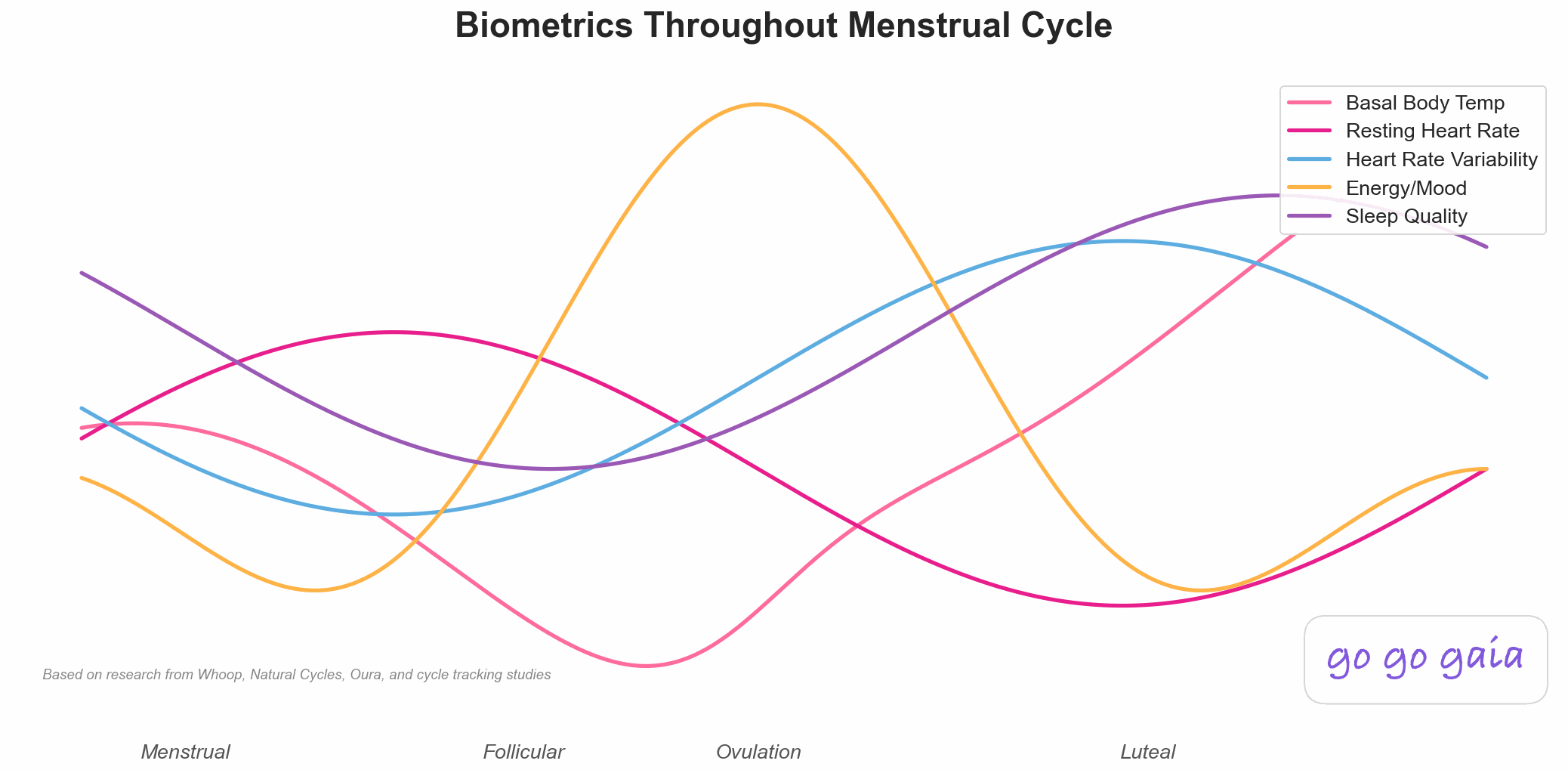
How Do Hardware, App, and Method Differ?
The confusion comes from treating "wearable" and "cycle app" as one thing. They're not. There are three separate layers here.
1. Hardware: what's on your body
An Oura Ring reads finger skin temperature. An Apple Watch Series 8 or later, any Apple Watch Ultra, or Apple Watch SE 3 has two wrist temperature sensors. Older Apple Watch SE models have none.[1] Both sample continuously overnight into one nightly average.
2. App layer: what reads that hardware
Oura's app turns ring data into Cycle Insights and a Readiness Score.[5] Apple's Health app turns watch data, plus anything you log manually, into native Cycle Tracking, including a retrospective ovulation estimate on compatible watches.[2] Each app only reads its own hardware.
3. Method: Natural Cycles is a separate product
Natural Cycles isn't a feature inside either app. It's its own app with its own FDA-authorized algorithm, and it can accept temperature from an Oura ring (Gen 2 or later), a compatible Apple Watch, or a manual thermometer.[12][13] Wearing the hardware doesn't connect it automatically. You have to link the device inside Natural Cycles and keep an active subscription there, separate from any Oura Membership, for the sync to work.
That's the part people miss: an Apple Watch feeds Apple's own Cycle Tracking by default, if it's on. It doesn't also feed Natural Cycles unless you've separately connected it. Both can run on the same watch, reading the same sensor, and stay unconnected.
What Do You Get With Oura?
Oura's ring reads temperature from the finger, closer to a stable core reading than a wrist exposed to open air.[1][11] It reports that as a deviation from your own baseline, not a raw number, and uses a sustained post-ovulation rise to flag a likely phase shift, refine period predictions, and mark a fertile window in Cycle Insights.[5]
Readiness Score is a separate, broader daily score combining temperature with sleep, HRV Balance, Activity Balance, and Recovery Index.[6] Temperature is asymmetric there: it can only pull Readiness down when your average runs high, never push it up.[7] A normal luteal-phase rise usually barely moves the score.
Hardware and Cost
The current Oura Ring 5 runs $399 in Silver at time of writing, September 2026.[10] Cycle Insights and Oura's other health features sit behind an Oura Membership: $5.99 a month or $69.99 a year, with a first month free for new members.[9] Check current pricing on Oura's site.
Data Export
Members can generate a printable PDF Cycle Insights report for a provider, or request a full CSV export through the Membership Hub or Oura's web dashboard. An API is also available.[8]
What Do You Get With Apple Watch and Apple Health?
Cycle Tracking in the Health app works on any iPhone from manual logging alone, no watch required. The wrist-temperature layer on top of that, the part that produces a retrospective ovulation estimate, needs an Apple Watch Series 8 or later, any Apple Watch Ultra, or Apple Watch SE 3.[1]
Apple asks for consistent sleep wear, at least 4 hours a night for 5 nights a week, plus Sleep Tracking and Sleep Focus on, across at least 2 full cycles before an estimate shows up.[2] It then appears as a light purple oval placed retroactively on your fertile window, since the progesterone rise the watch looks for only happens after ovulation. Apple's Cycle Tracking Instructions for Use caution against using the predicted fertile windows as a form of birth control.[3]
Hardware and Cost
No separate subscription. Cycle Tracking is built into the free Health app, and the wrist-temperature layer costs nothing extra on a compatible watch you already own.
Data Export
From the Health app's Summary tab, tap your profile icon and choose "Export All Health Data" for a single XML file covering your full history, cycle data included.[4] It's a raw export for portability, not a formatted report.
Where Does Natural Cycles Fit?
Natural Cycles predates both wearable features above. It started with manual basal body temperature, then added the option to pull overnight temperature from a compatible device instead.[12]
It lists Oura compatibility from Ring Gen 2 on, with Gen 3 and up needing both a Natural Cycles subscription and an active Oura Membership for the sync.[12] On Apple Watch, it supports Series 8 and later, any Ultra, and SE 3, the same sensor-equipped models Apple's own Cycle Tracking uses.[13]
What it produces also differs in kind from a retrospective estimate. Instead of one marker after the fact, its algorithm gives a daily status, confirming whether that day counts as fertile, using the temperature trend it's built up over time.[12] That design is what its FDA clearance covers.
Cost
Natural Cycles runs on its own subscription, monthly or annual, separate from any Oura Membership you'd also need to sync ring data.[14] Exact current pricing wasn't listed on its public marketing pages at time of writing, so check naturalcycles.com directly.
Data Export
Natural Cycles can email a CSV of your daily entries, logged temperatures and period dates included, on request through its help center, and it can generate an in-app PDF cycle report covering your last six cycles for a provider.[15]
Side-by-Side Comparison
| Oura | Apple Watch + Apple Health | Natural Cycles | |
|---|---|---|---|
| Hardware | Oura Ring, finger sensor | Series 8+, Ultra, or SE 3, wrist sensors | None of its own. Borrows Oura, Apple Watch, or a manual thermometer |
| What's measured | Finger skin temperature, overnight | Wrist skin temperature, overnight | Whatever temperature its connected source feeds it |
| App layer | Oura app: Cycle Insights + Readiness | Apple Health: native Cycle Tracking | Its own NC app, separate from both |
| Retrospective vs predictive | Retrospective phase and fertile-window flagging | Retrospective ovulation estimate only | Daily fertile / not-fertile status from its own algorithm |
| Subscription cost | ~$399 ring + $5.99/mo or $69.99/yr membership | Free, built into iPhone | Own monthly/annual plan. Add Oura Membership if syncing a Gen 3+ ring |
| Data export | PDF reports, CSV via Membership Hub, API | Full history as one XML file | CSV by email request, 6-cycle PDF report in-app |
Prices and features as published at time of writing, September 2026. Confirm current details on each company's site before buying.
Does a Logging App Still Have a Job?
All three above infer your cycle from temperature. The sensors don't ask how you're actually feeling. A ring or watch can't sense cramps, mood, medication, or a lab result your doctor sent you, and none of the three are built around showing whether your energy dips line up with a cycle phase over several months.
That's a separate job, one a logging app can do alongside any setup above, not instead of it. A tracking app like Veya can sit on top of manual entries for symptoms, mood, sleep, fitness, and uploaded labs, and show correlations, like fatigue clustering in the days before a temperature-based phase shift. It doesn't replace the sensing itself. It fills in what a thermometer, wrist or finger, was never built to capture.
Which Setup Fits You?
Oura fits if:
- You want a dedicated sleep and readiness ring, and cycle tracking is a bonus
- You don't already wear an Apple Watch and don't want one
- You're fine paying for hardware plus an ongoing membership
Apple Watch + Apple Health fits if:
- You already own a compatible Apple Watch
- You want cycle tracking with no extra app or subscription
- A retrospective estimate, confirmed a day or two late, is enough for what you're trying to learn
Natural Cycles fits if:
- You want to research an FDA-cleared, algorithm-based method directly with the company and a healthcare provider
- You're fine paying for a dedicated subscription on top of any wearable you already own
- You want a daily status rather than one after-the-fact marker
A logging app fits if:
- You want symptoms, mood, habits, and labs tracked alongside whatever temperature data your ring or watch produces
- You're trying to spot patterns across several cycles, not just the current one
- You're on iOS, since Veya's full app experience is iOS only (a web app covers other platforms)
Curious how Apple's native feature or Natural Cycles compares to a dedicated period app? Our Flo vs Apple Health Cycle Tracking and Flo vs Natural Cycles guides go deeper on those pairings.
Frequently Asked Questions
Does wearing an Apple Watch automatically make Natural Cycles work?
No. An Apple Watch with a temperature sensor doesn't feed Natural Cycles on its own. You have to connect it inside the Natural Cycles app, with an active subscription, before any temperature data moves between them. Without that, the watch is only feeding Apple's own Cycle Tracking, or nothing cycle-related at all.
What's the difference between Apple's Cycle Tracking and Natural Cycles?
Apple Health's Cycle Tracking is free and built into every iPhone. On a Series 8 or later, any Ultra, or SE 3, it can also place a retrospective ovulation estimate on your fertile window after your temperature has already risen. Natural Cycles is a separate, subscription-based app with its own FDA-authorized algorithm that gives a daily fertility status instead. This article explains how each layer works. It isn't guidance on using either for contraception, which is a conversation for a healthcare provider.
Do I need an Oura membership to use Oura with Natural Cycles?
If you're on an Oura Ring Gen 3 or later, yes. Natural Cycles' device page states you need both a Natural Cycles subscription and an active Oura Membership to sync temperature data. Compatibility goes back to Oura Gen 2, so check current requirements on both sites before buying either product for this purpose.
Can I export my cycle and temperature data from these apps?
Yes, all three offer some path. Apple's Health app exports your entire history, cycle data included, as one XML file from the Summary tab. Oura offers printable PDF Cycle Insights reports plus a full CSV request through its Membership Hub or web dashboard. Natural Cycles emails a CSV of your daily entries on request and can generate an in-app PDF cycle report covering your last six cycles.
Is Oura or Apple Watch better for cycle tracking?
Neither is more accurate in any clearly established way. Both rely on the same overnight temperature-and-baseline approach, just measured at different spots: a ring at the finger, a watch at the wrist. If you already wear one for sleep or fitness, its cycle feature comes free with Apple Watch or with an Oura Membership. Buying hardware just for cycle tracking usually comes down to what else you want the device to do day to day.
Go Deeper on the Mechanics
This guide covers how the three fit together. For a closer look at any one layer, these go further:
- How Wearables Detect Your Cycle: The Tech Explained →
- Oura Cycle Insights & Readiness: What They Measure →
- Apple Watch Ovulation Estimates: How They Work →
- Apple Watch vs Oura vs Garmin: Which Wins for Cycle Tracking? →
Related Articles
- Flo vs Apple Health Cycle Tracking: What You Give Up (2026)
- Flo vs Natural Cycles: Which One Should You Use?
- Clue vs Natural Cycles: Which One Should You Use?
References
- Apple Inc. Findings from Apple Women's Health Study advance science around menstrual cycles. Apple Newsroom, March 2023. Device compatibility, including SE exclusion, per Natural Cycles. Apple Watch Devices. naturalcycles.com/apple-watch. Fetched September 2026.
- Apple Inc. Receive retrospective ovulation estimates on Apple Watch. Apple Support. support.apple.com/en-us/120357
- Apple Inc. Cycle Tracking Instructions for Use. apple.com/legal/ifu/cycle-tracking
- Apple Inc. Share your data in Health on iPhone. Apple Support (iPhone User Guide). support.apple.com/guide/iphone
- Oura Health Oy. Cycle Insights. Oura Help Center. support.ouraring.com
- Oura Health Oy. Readiness Score. Oura Help Center. support.ouraring.com
- Oura Health Oy. Body Temperature. Oura Help Center. support.ouraring.com
- Oura Health Oy. Export & Share Your Oura Data. Oura Help Center. support.ouraring.com
- Oura Health Oy. Oura Membership. ouraring.com/membership. Fetched September 2026.
- Oura Health Oy. Oura Ring 5, Silver. Oura Store. ouraring.com/store. Fetched September 2026.
- Maijala A, Kinnunen H, Koskimäki H, Jämsä T, Kangas M. Nocturnal finger skin temperature in menstrual cycle tracking: ambulatory pilot study using a wearable Oura ring. BMC Womens Health. 2019;19(1):150. doi:10.1186/s12905-019-0844-9
- Natural Cycles. Devices. naturalcycles.com/devices and Natural Cycles Powered by Oura. naturalcycles.com/oura. Fetched September 2026.
- Natural Cycles. Apple Watch Devices. naturalcycles.com/apple-watch and Natural Cycles now integrates with Apple Watch. naturalcycles.com/cyclematters. Fetched September 2026.
- Natural Cycles. FAQs: How Much Does Natural Cycles Cost & More. naturalcycles.com/faqs. Fetched September 2026.
- Natural Cycles. How to download your Natural Cycles data. Help Center. help.naturalcycles.com
- FDA De Novo database, DEN170052 (Natural Cycles, granted 08/10/2018): accessdata.fda.gov. Also announced via PR Newswire. US Food And Drug Administration (FDA) Clears Natural Cycles As The First Digital Method Of Birth Control In The United States. August 2018. prnewswire.com
Facts checked against official pages and FDA/peer-reviewed sources, September 2026. Prices and device compatibility change, so confirm on each company's site.
Log What Your Wearable Can't
Temperature tells you where you are in your cycle. It doesn't log symptoms, mood, or how your workouts and sleep line up with it. Veya does that alongside whatever wearable you already use.