Why Is My Period Tracker Always Wrong? (And What Helps)
You logged your period, the app gave you a confident date for the next one, and it missed by a week. Again. It's not that the app is broken. It's guessing from an average, and averages fall apart the moment your cycle doesn't cooperate.
Educational content, not medical advice. For personal concerns, please consult your doctor.
Quick Answer: Why Is My Period Tracker Always Wrong?
Period trackers predict your next period by averaging your past cycle lengths, not by measuring anything happening in your body right now. That prediction is only as good as how consistent your cycles actually are. The main reasons it misses:
- Your cycle length naturally varies month to month, and averages smooth over that variation
- Ovulation shifts earlier or later in response to stress, illness, travel, or no clear reason at all
- Some apps default toward a 28-day assumption before you've logged enough history
- Post-pill, breastfeeding, and perimenopausal cycles are structurally less predictable, no matter which app you use
This is one of the most common complaints about period tracking apps, and it makes sense once you see how the prediction actually works under the hood. Let's go through the mechanics of why these dates miss, and what's worth doing instead of chasing a single predicted date.
How Period Trackers Actually Predict Your Next Period
Most apps use a version of the same method: take your last several cycle lengths, calculate an average (sometimes weighted toward more recent cycles), and predict your next period that many days after your last one started.
That's a reasonable approach when cycles are close to consistent. The problem is that "consistent" is doing a lot of work in that sentence. A typical adult cycle runs about 21 to 35 days, and it's completely normal for your own cycle to vary by several days from one month to the next.[1] An average can only represent a single number. Your actual cycle length that month is going to be higher or lower than that number more often than it matches it exactly.
Averages vs. Your Actual Variability
Here's the part that trips people up: even a "regular" cycle isn't the same length every single month. If your cycles run 27, 31, 29, and 33 days over four months, your average is 30, but not one of those actual cycles was 30 days. Any prediction based on that average was off by 1 to 3 days every time, and that's a relatively mild case of variability.
The wider your month-to-month range, the further a single-date prediction can miss. This is normal cycle behavior, not a flaw unique to any one app.
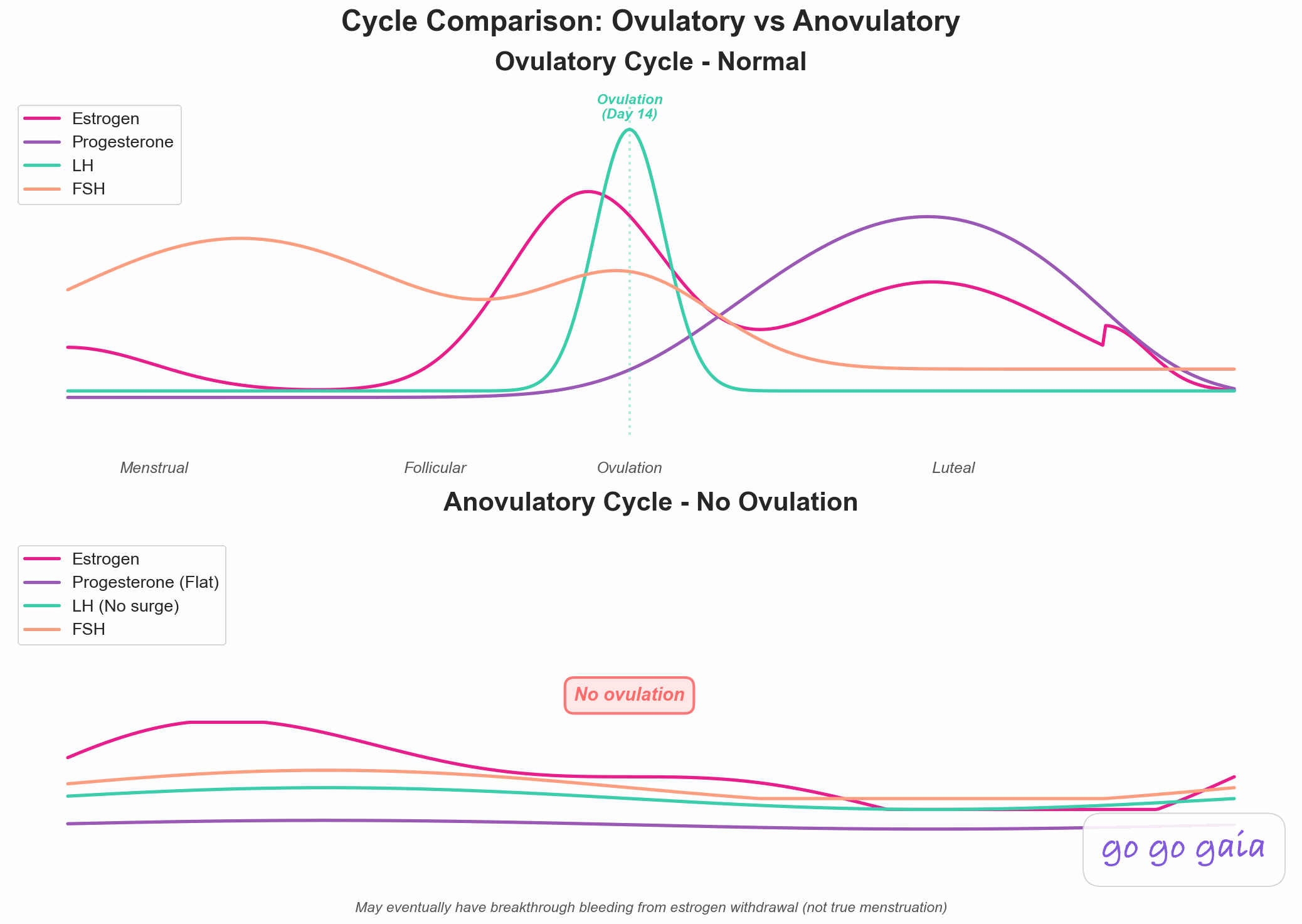
Cycle length and ovulation timing can vary more than a single averaged prediction can account for.
Why Ovulation Timing Moves the Whole Prediction
Your period follows ovulation by roughly two weeks, so anything that shifts ovulation shifts your period date too. Stress, poor sleep, illness, travel, and changes in exercise or weight can all nudge ovulation earlier or later, sometimes by several days, sometimes with no obvious trigger at all.
Apps that estimate ovulation purely from calendar math (counting back roughly 14 days from an assumed period date) are estimating a moving target using another estimate. Apps that instead use logged signals like basal body temperature or LH test results have more to work with, but even those are still estimating from indirect data, not measuring ovulation directly.
The 28-Day Default Problem
Before an app has enough of your own history to work from, many default toward a 28-day cycle as a starting assumption. That's a reasonable placeholder in the absence of data, but it's also just an average pulled from population-level studies, not a target your body is trying to hit.
If your actual average is closer to 24 or 34 days, early predictions built on a 28-day default will be off before the app has learned enough about you specifically. This usually improves as you log more cycles, but it explains why predictions in the first few months of using a new app tend to be the least reliable.
What Wearable Data Adds (and Doesn't)
Wrist or body temperature, resting heart rate, and heart rate variability can shift in patterns tied to your cycle, and some apps and wearables use those signals to refine a prediction rather than relying on calendar math alone.[2] That additional data can narrow the estimate, especially around ovulation.
It's worth being clear about what this is and isn't. It's still a retrospective estimate built from indirect signals, not a direct measurement or confirmation of ovulation. Synced biometric data is a useful addition to a prediction model. It isn't a guarantee of accuracy on its own. If calendar-only prediction is what's letting you down, our guide to what LH strips, BBT, wearable temperature, and lab panels each actually measure breaks down the physiological signals that move a prediction beyond pure averaging.
When Predictions Are Structurally Unreliable
Some situations make accurate prediction genuinely hard, regardless of which app you're using, because the underlying cycle itself hasn't settled into a pattern yet:
- After stopping hormonal birth control. Your natural cycle has to re-establish itself, and that process can take a few months with irregular timing along the way.
- While breastfeeding. Nursing hormones can suppress or delay ovulation, so cycles are often irregular or absent for a stretch postpartum.
- During perimenopause. Hormone levels fluctuate more in the years before menopause, and cycles commonly get longer, shorter, or less predictable as a result.
In all three cases, low prediction accuracy reflects what's actually happening in your cycle, not a shortcoming specific to one app. If your cycles are irregular for any reason, our roundup of the best period trackers for irregular cycles covers apps built around pattern tracking instead of a single predicted date. For a broader look at how accuracy is measured across apps, see our guide to how accurate period tracker apps really are.
What to Do Instead of Chasing a Single Date
Once you stop expecting a single predicted date to be reliable, a few things become more useful than staring at a countdown.
Log consistently, not just when you remember. A prediction model is only as good as the history it's built from. A cycle you forgot to log is a gap the app has to guess across, which widens the error on whatever comes next.
Watch your own range, not a single number. If your last six cycles ran between 26 and 34 days, that range is more honest and more useful than a single predicted date sitting somewhere in the middle of it.
Log symptoms alongside cycle days. Even when the date prediction is off, a running record of symptoms often reveals its own pattern, things like cramping, mood, or energy shifts that show up reliably even when the calendar date doesn't.
Treat wearable data as a helpful input, not an answer. If your app syncs temperature or heart rate data, use it to sharpen your sense of your own pattern over time rather than expecting it to produce a single guaranteed date.
A range beats a single guessed date
No app can predict a moving target perfectly. What actually helps is a record of your own cycle history and symptoms, so you can see your real pattern instead of chasing one date.
Go Go Gaia logs your cycles and syncs wearable data where available, and shows you patterns across cycles rather than betting everything on a single predicted day.
Log Your Next 3 CyclesThe Bottom Line
Your period tracker isn't malfunctioning when it misses a date. It's doing what it was built to do: average your past cycles and guess. That guess is only as good as how consistent your body's timing actually is, and ovulation, stress, and life circumstances all have a say in that. The fix isn't finding a "more accurate" app so much as shifting what you expect from prediction, and leaning on your own logged pattern instead of a single forecasted date.
Related Reading
Stop chasing one date. Start seeing the pattern.
Log a few cycles and you'll know your real range and what's actually shifting it, instead of waiting on a single guess.
Try Go Go Gaia Free