Do Period Apps Work During Perimenopause?
Short answer: the prediction part gets less reliable, but the tracking part becomes more valuable, not less. Here's what actually changes, why cycle forecasts start missing, and what to look for in an app once your cycle stops behaving like a textbook 28 days.
Educational content, not medical advice. For personal concerns, please consult your doctor.
Quick Answer: Do Period Apps Work During Perimenopause?
Yes and no, depending on what you're using them for.
- Prediction accuracy drops. Apps that forecast your next period from an average cycle length struggle once cycles start varying widely, which is normal in perimenopause.
- Tracking value goes up. A logged record of your actual cycle lengths, symptoms, and how they're drifting over time is genuinely useful, both for you and for a doctor.
- Feature fit matters more than brand. The apps that hold up are the ones built to log a wide range of symptoms and irregular cycles, not just count down to a predicted date.
You've used a period app for years. It knew your rhythm, the countdown was usually right within a day, and then, sometime in your 40s, it just stopped being accurate. Predicted dates come and go with no period. Or your period shows up two weeks "early" and the app treats it like an anomaly. It's not broken. Your cycle is doing what cycles do in perimenopause, and the app's prediction model was never built for that.
This guide covers what actually changes about tracking during perimenopause, why the forecasting math breaks down, and what still works (and works better than ever) once you stop expecting a countdown clock and start using the app as a record.
Why Cycle Predictions Get Less Reliable
Most period apps predict your next period the same way: they average your last several cycle lengths and project forward. That works reasonably well when your cycles cluster around a consistent number, say 27 to 30 days, month after month.
Perimenopause disrupts the input the math depends on. As ovarian hormone production becomes less predictable in the years leading up to menopause, ovulation itself becomes irregular. Some cycles run shorter, some stretch much longer, and some skip a period entirely.[1] Our complete guide to perimenopause covers the full symptom and timeline picture, but the short version for tracking purposes is this: there's no longer a stable average to average.
Here's what that instability tends to look like on a chart. Instead of a repeating rhythm, hormone levels swing unevenly from cycle to cycle:
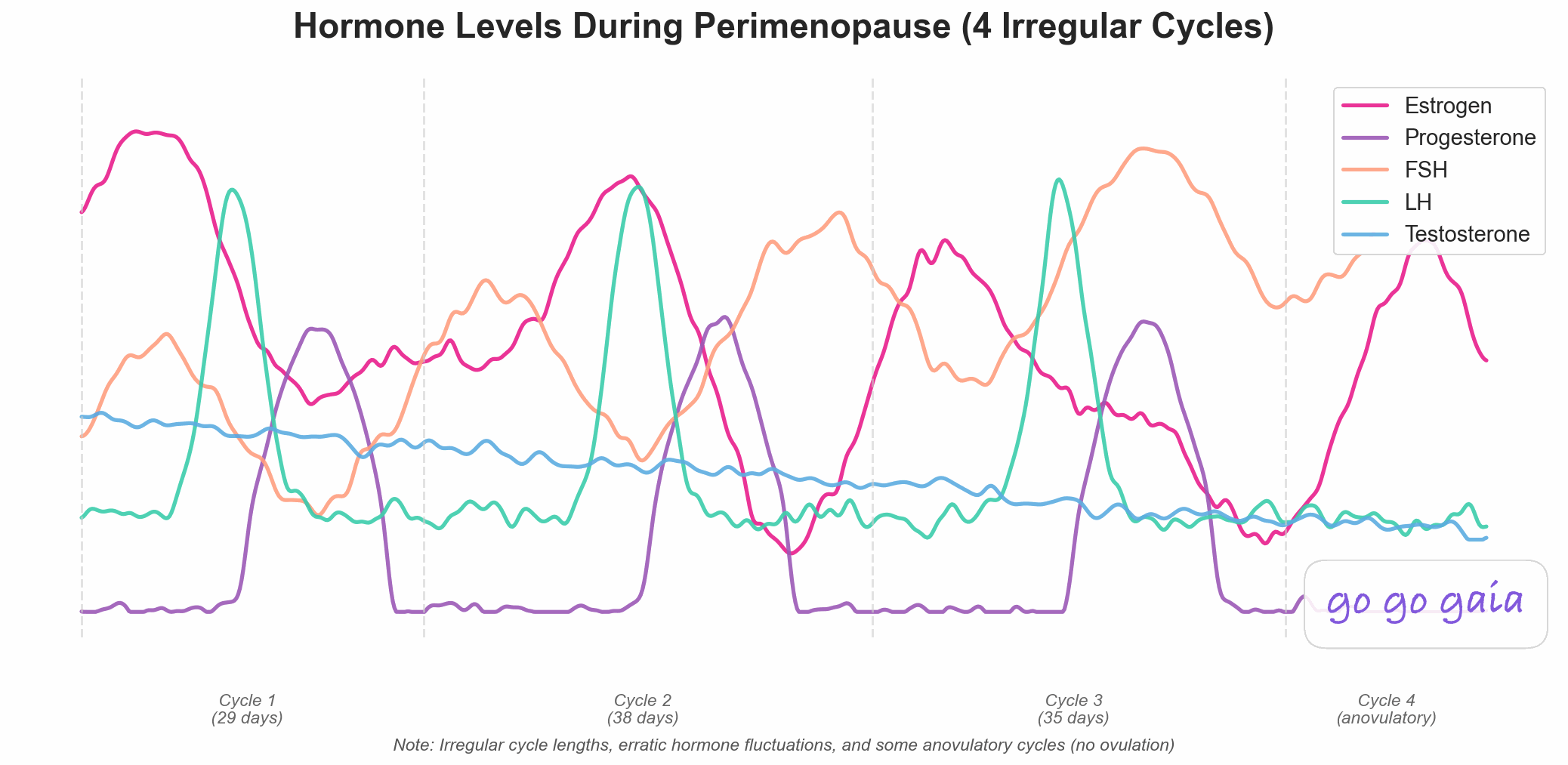
Irregular hormone swings are why a "predicted next period" date gets less reliable in perimenopause, not a sign that anything's wrong with the app.
So when a predicted date is off by a week or two, that's usually the underlying biology, not a bug. It's worth knowing going in so a missed prediction doesn't read as alarming on its own. It's a similar story for anyone tracking a cycle after stopping birth control, since prediction there is also catching up to a cycle that hasn't settled into a pattern yet.
What Actually Gets More Useful
It sounds counterintuitive, but the less predictable your cycle gets, the more valuable a logged record becomes. A few reasons why:
- You can see the drift, not just guess at it. A single irregular cycle doesn't mean much. Six months of logged cycle lengths shows whether you're trending shorter, longer, more variable, or some mix, which is exactly the shape perimenopause takes.
- Symptom patterns become visible. Hot flashes, sleep disruption, and mood shifts often show up before periods become obviously irregular. Logging them alongside your cycle can surface a pattern weeks or months before you'd otherwise notice one.
- It's the record your doctor actually wants. A description of "my periods have been weird lately" is much less useful in an appointment than a dated log of cycle lengths and symptoms over several months.
In other words, the job of the app shifts. It stops being a countdown clock and starts being a notebook. That's a smaller ask, but it's arguably the more important one during this transition.
What to Look For in a Tracking App
If you're evaluating apps specifically for perimenopause, prediction accuracy shouldn't be the deciding factor, since no app can predict what an erratic cycle hasn't decided yet. Instead, look at:
- Symptom breadth. Does it let you log hot flashes, night sweats, sleep quality, and mood, not just bleeding and cramps? Perimenopause symptoms extend well past the classic period-tracking checklist.
- No rigid cycle-length assumptions. Some apps get confused, or start flagging things as "irregular" in a way that feels alarming, when a cycle falls outside a fixed 21-to-35-day window. Look for one that logs what happens without treating an unusual cycle as an error.
- Long-range trend views, not just next-cycle countdowns. A chart of cycle length over 6 to 12 months tells you far more in perimenopause than a single predicted date.
- Room to log skipped cycles. Missed periods are common and expected in perimenopause. The app should handle that gracefully rather than treating a gap as missing data.
A tracking app like Go Go Gaia logs symptoms like hot flashes, sleep, and mood alongside your cycle, so you can see how they're shifting together over months rather than checking each one in isolation. That's the kind of view that matters most once prediction alone stops being reliable.
If you want a side-by-side look at how specific apps handle this, our comparison of perimenopause tracking apps covers eight options and where each one holds up. And if you're just starting to notice changes and want the fuller picture of what perimenopause involves, the perimenopause guide is the place to start.
The record matters more than the prediction
Once your cycle stops following a pattern an algorithm can guess, the useful thing an app can do is show you your own pattern of change instead. That's what a doctor will actually ask for if perimenopause symptoms come up in an appointment.
Go Go Gaia logs your cycle length, symptoms, sleep, and mood together, so you can see the drift over months rather than guessing at a single predicted date.
Start a 3-Month Symptom LogThe Bottom Line
Period apps don't stop working in perimenopause, but what they're good for changes. Expect predicted dates to get less reliable as cycles become irregular, that's biology, not a glitch. What stays useful, and gets more useful, is the tracking itself: a dated record of your cycle lengths and symptoms that shows the pattern of change over time. Pick an app built to log that breadth of symptoms without assuming a rigid cycle length, and the tracking will keep earning its place even after the countdown clock stops being trustworthy.
Related Reading
- Complete Guide to Perimenopause: Symptoms, Timeline & What to Expect
- Best Perimenopause App 2026: 8 Apps Compared
- Best Period Tracker for Irregular Cycles (2026)
- Menopause Guide: Symptoms, Timeline & What Comes After Perimenopause
- Can You Log HRT Doses and Symptoms in a Cycle App?
- Perimenopause Tracker
Stop waiting on the countdown. Start watching the trend.
A few months of logged cycles and symptoms will tell you more about what's actually happening than any single predicted date.
Try Go Go Gaia Free