Tracking Your Cycle After Stopping Birth Control
Your first few cycles off the pill or after an IUD removal rarely look like a textbook 28-day calendar. This guide covers what's actually worth logging during that stretch, why your app's predictions lag behind, and how tracking tools handle the transition.
Quick Answer
Cycles are commonly irregular for a while after stopping hormonal birth control, as your body's own signaling takes back over from the medication.[1] During that window, the most useful thing to do is log bleeding, symptoms, energy, and mood as they actually happen, not as you expect them to.
Prediction features in tracking apps need a run of logged cycles before they can find a pattern, so don't expect an accurate forecast right away. This page isn't about when to start or stop birth control, that's a decision you've already made. It's about what to do with your tracking app once you have.
Educational content about tracking, not medical or contraceptive advice. For questions about your specific cycle or birth control history, please consult your doctor.
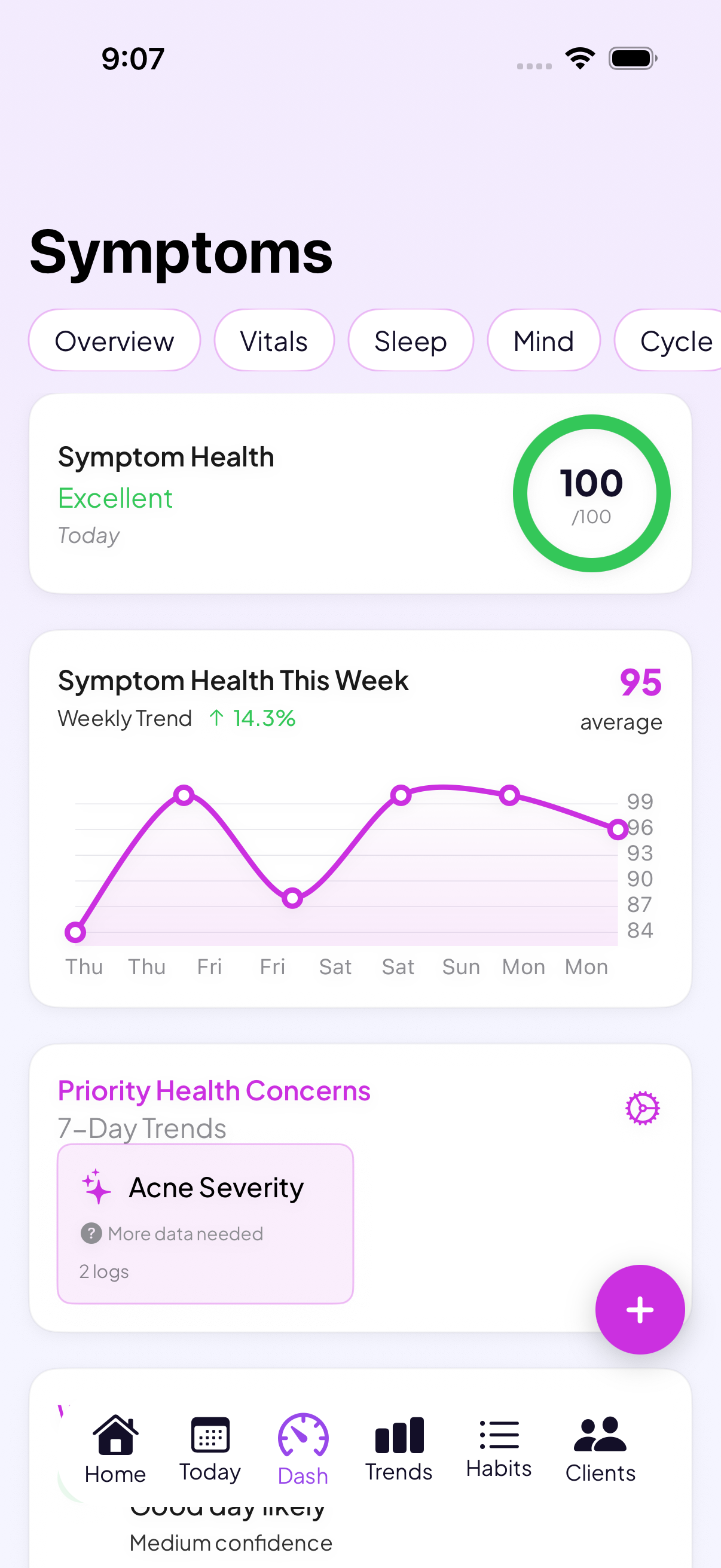
Logging what's actually happening, even when it doesn't match a typical cycle, is what a tracking app needs to work with.
Coming off the pill, the patch, the ring, or having an IUD removed, is one of the more common reasons people start using a period tracker for the first time, or open one after months of it sitting unused. The problem is that most tracking apps are built around a fairly regular cycle, and your first several cycles off birth control often aren't that.
This isn't a guide about the decision to stop birth control. That's already made, and it's not ours to weigh in on. This is about the practical question that follows: what do you actually log, and how should you think about your app's predictions, while your cycle finds its own rhythm again.
Why Cycles Are Often Irregular at First
While you're on hormonal birth control, the medication is doing a lot of the work of setting your bleeding schedule. The "period" many people have on the pill is a withdrawal bleed tied to the pill pack, not necessarily an ovulatory cycle. Once you stop, your own hypothalamic-pituitary-ovarian signaling has to resume driving the cycle, and that transition doesn't run on a fixed schedule.[1]
There's also a simpler explanation worth naming: if your cycles were irregular before you started birth control, that pattern was often masked, not resolved, while you were on it.[1] Stopping doesn't create irregularity from nothing so much as it can reveal a pattern that was already there underneath the medication.
Cycles vary a lot from person to person in this window. Some people see a fairly quick return to a familiar rhythm. Others see longer or shorter cycles, spotting, or a delayed first period for a while before things settle into a pattern. There's no single expected timeline here, which is exactly why logging matters more than predicting during this stretch.
What's Worth Logging
You don't need to log everything perfectly. A few categories carry most of the value while your cycle is re-establishing itself.
Bleeding, Even When It's Odd
Log the start date, end date, and flow of any bleeding, spotting included, even if it doesn't look like your idea of a normal period. Light, heavy, short, or irregular bleeding in these first cycles is still data. Skipping the log because "it doesn't count" removes the exact information that will eventually show you the pattern.
Symptoms
Cramping, breast tenderness, headaches, and other physical symptoms often shift as your hormones stop being regulated by medication. Logging them alongside bleeding can surface a rhythm in symptoms before your bleeding pattern itself becomes predictable.
Energy and Sleep
Energy dips, changes in sleep quality, and general fatigue are common things people notice in the months after stopping birth control. They're easy to dismiss as unrelated, but logged consistently, they can line up with a phase of your emerging cycle.
Mood
Mood can shift for reasons that have nothing to do with your cycle, but logging it daily during this window gives you a record to look back on. Over a few months, you may start to see mood entries cluster around certain points in your bleeding pattern, which is useful information whether or not it turns out to be hormonally driven.
Why Predictions Lag Behind
Period tracker predictions work by finding a pattern across several logged cycles and projecting it forward. That's true for a brand-new user and for someone whose history the app hasn't seen in a while, and it applies just as much right after stopping birth control.
If your first few post-birth-control cycles vary in length, an app that tries to predict too early will likely get it wrong, simply because there isn't yet a stable pattern to learn from. Most apps get more accurate as more cycles are logged, and that's especially true here: the algorithm needs your data as much as you need its forecast.
The practical takeaway is to treat early predictions as a placeholder, not a schedule. Logging consistently is what shortens the gap between "the app doesn't know yet" and "the app has a pattern to work from." If it's been a while since you've had a period at all, our guide on the best period trackers for irregular cycles goes deeper into how different apps handle unpredictable timing generally.
The Pill vs the IUD: A Different Starting Point
The method you were using changes what your first tracked cycle looks like.
Coming off the pill, patch, or ring: You're usually going from a medication-scheduled withdrawal bleed to your body's own cycle. The first true period can arrive close to when you'd expect a withdrawal bleed, or it can take longer, and the cycles after that can vary before settling.
Removing a hormonal IUD: Many people have very light or no bleeding while a hormonal IUD is in place, sometimes for years. After removal, the first real period can feel unfamiliar simply because there's little recent bleeding data to compare it to, even though the underlying hormonal transition is similar to stopping other hormonal methods.
Removing a copper IUD: Because a copper IUD is non-hormonal, periods generally continue as usual while it's in place. Removal tends to involve less of an adjustment window for the cycle itself, though the reason for removal (for example, trying to conceive) may bring its own tracking questions that fall outside what this page covers. For a broader look at how different contraceptive methods compare, our birth control methods guide covers the pill, IUDs, and other options side by side.
How Tracking Apps Handle the Transition
Most period trackers don't have a dedicated "post-birth-control" mode. What matters more than any special feature is how easy the app makes it to log an atypical cycle without friction, and how clearly it communicates that predictions are still warming up rather than presenting an early guess as a confident forecast.
Look for an app that lets you log bleeding, symptoms, energy, and mood quickly, without requiring the entry to fit a "normal" cycle shape. A tracker that only wants a start and end date for a textbook period will lose the nuance that matters most in this window, like spotting between cycles or a symptom pattern that doesn't yet line up with bleeding.
Go Go Gaia's logging is built around quick, one-tap entries for bleeding, symptoms, mood, and energy, which is useful here specifically because it doesn't ask you to fit an irregular cycle into a predefined shape. You log what happened, and the correlation view shows you how your entries relate to each other once there's enough data to see a pattern, rather than forcing a prediction before the data supports one.
Frequently Asked Questions
Educational information, not medical or contraceptive advice. For personal concerns, please consult your doctor.
Why is my cycle irregular after stopping birth control?
While you're on hormonal birth control, the medication is largely setting your bleeding schedule rather than your own hormones. Once you stop, your body's own hormonal signaling has to take that job back over, and that process doesn't happen on a fixed timeline. If your cycles were irregular before you started birth control, that underlying pattern is often still there and simply wasn't visible while the medication was regulating things.
What should I log while my cycle is re-establishing?
Bleeding is the most useful thing to log: start date, end date, and flow, even if it doesn't look like a typical period at first. Beyond that, symptoms, energy, mood, and sleep are worth tracking too, since they can show a pattern before your bleeding does. The point isn't to force a prediction early. It's to build a record you and your app can both work from.
Why do period tracker predictions struggle right after stopping birth control?
Prediction algorithms in period trackers work by finding a pattern across several past cycles. Right after stopping birth control, there usually isn't a stable pattern yet to learn from, since cycle length and timing can vary more than usual during this window. Apps generally need a handful of logged cycles before predictions start to tighten up, and that's true after stopping birth control just as it is when starting to track for the first time.
How is tracking after an IUD different from tracking after the pill?
It depends on the type of IUD. With a hormonal IUD, many people have very light or absent bleeding while it's in place, so removal can mean logging a first real period in years with little recent data to compare it to. With a copper IUD, periods usually continue throughout, so there's often less of an adjustment window after removal. Either way, the same approach applies: log what you see and let the pattern build.
Does an irregular cycle after birth control mean something is wrong?
Temporary irregularity is a commonly described experience after stopping hormonal birth control, not something a tracking app can diagnose one way or the other. If irregularity continues for an extended period or comes with symptoms that concern you, that's a conversation for your doctor, who can look at your specific history. This article covers what's worth logging, not what a given pattern means medically.
The pattern shows up in the log, not the prediction.
Track your bleeding, symptoms, energy, and mood as they actually happen this cycle, however irregular. That's what turns into a pattern your app, and your doctor, can actually use.
Start Logging This CycleStill deciding? Just log one cycle and see what it shows.
References
- Mayo Clinic Staff. Birth control pill FAQ: Benefits, risks and choices. Mayo Clinic. mayoclinic.org/tests-procedures/combination-birth-control-pills/in-depth/birth-control-pill
- American College of Obstetricians and Gynecologists. What to Know About Skipping Periods With Birth Control. ACOG. acog.org/womens-health/experts-and-stories/the-latest/what-to-know-about-skipping-periods-with-birth-control
Related Reading
Best Period Tracker Apps for Irregular Cycles
How different apps handle unpredictable cycle timing, and which ones fit this exact window.
How to Choose Birth Control: 12 Methods Compared
The pill, IUDs, implants, and more, compared on effectiveness, hormones, and period impact.
Cycle Tracking With an IUD and No Period
What's worth logging when a hormonal IUD means little or no bleeding to track.
How to Tell If You're Ovulating
The signs of ovulation and what temperature, LH tests, and cervical mucus each tell you.