Postmenopause: What Changes After Your Final Period (and What Helps)
You've been through perimenopause. Your periods finally stopped. Now what? Postmenopause isn't a phase you pass through — it's the stage you live in for the rest of your life. Here's what actually changes after your final period, what settles down, and what's worth paying attention to long-term.
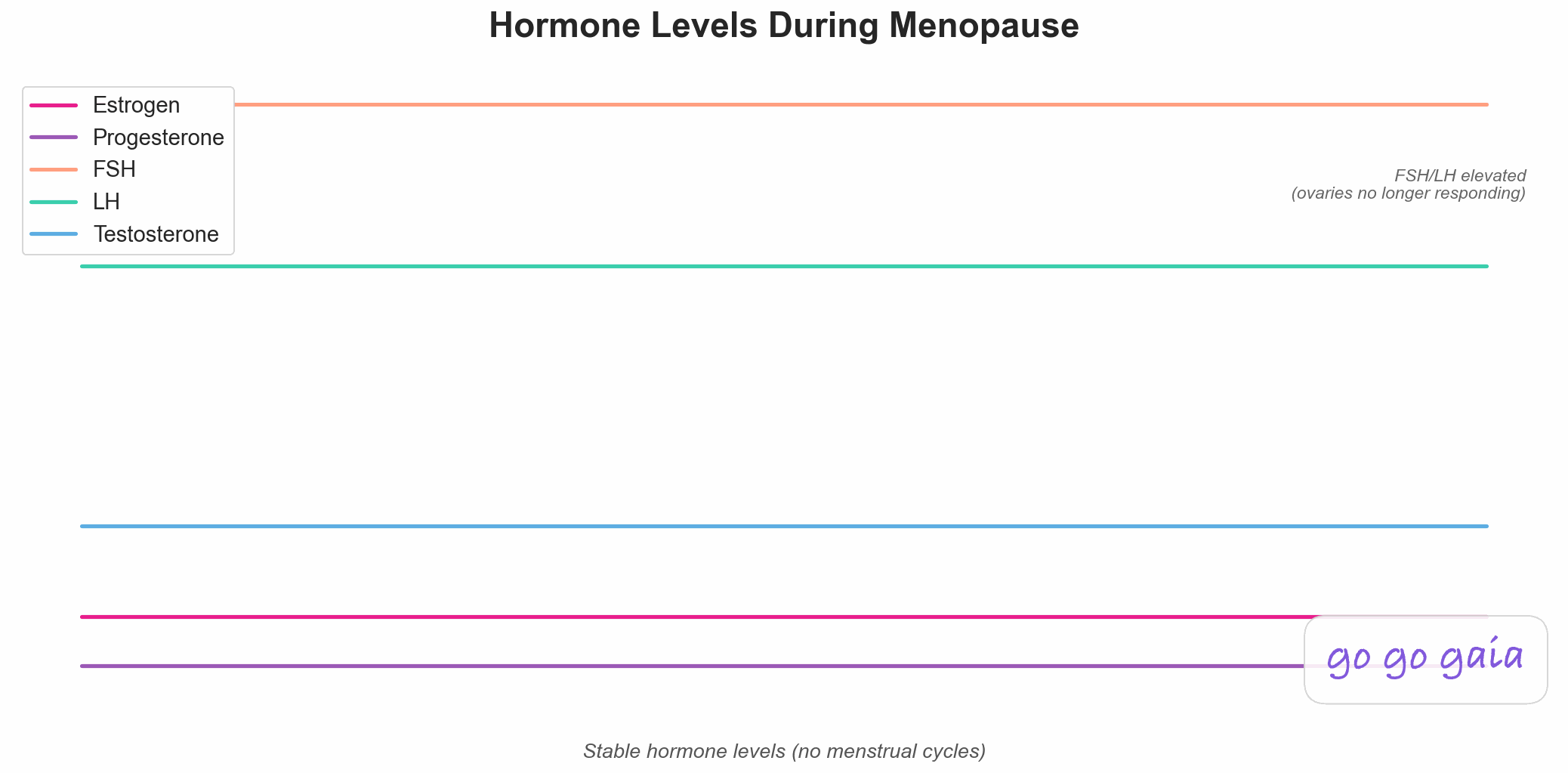
Postmenopause: stable, flat hormone levels with no more cycles
Educational content, not medical advice. For personal concerns, please consult your doctor.
Quick answer: what is postmenopause?
Postmenopause begins the moment you've gone 12 consecutive months without a period — on average around age 51 — and it lasts the rest of your life. Estrogen and progesterone settle at new, permanently low levels, so the unpredictable swings of perimenopause come to an end. Some symptoms, like hot flashes and disrupted sleep, can linger for years; meanwhile, consistently low estrogen brings longer-term shifts in bone, heart, and urogenital health that are worth understanding early.
Your period didn't come last month. Or the month before. Or for the past year. You spent so long in those erratic perimenopause cycles that you half-expected it to show up again.
But 12 months have passed since your last period. By the medical definition, you've now reached menopause — and everything from here on is postmenopause.
Except nothing feels like a finish line. You may still have hot flashes. Sleep might still be patchy. The "after" can feel less like an ending and more like a new normal you weren't fully briefed on.
So what actually changed when you crossed that 12-month mark? What eases, what lingers, and what deserves a bit of long-term attention? Here's the postmenopause picture — the years that make up the largest stretch of your reproductive life, even though they get talked about the least.
Menopause, Perimenopause, Postmenopause: Which Is Which?
The words get used interchangeably, but they describe different things — and in postmenopause the distinction finally clicks into place:
- Perimenopause: The transition leading up to your final period, typically lasting 4–8 years. Hormones swing, periods get irregular, and symptoms come and go. If that's where you are, our complete perimenopause guide covers the early signs, timeline, and what helps.
- Menopause: Not a phase but a single point in time — the day you've gone 12 consecutive months without a period. You can only confirm it looking backward.
- Postmenopause: Everything after that point. This is where you'll spend the rest of your life, and it's what this guide is about.
When people say "I'm going through menopause," they usually mean perimenopause — the transition with all the fluctuation. When they say "I'm in menopause," they technically mean postmenopause. The reason it matters here is simple: the advice that fits perimenopause (riding out unpredictable swings) isn't quite the advice that fits postmenopause (living well with steady, low hormones over the long run).
If you're still in that fluctuating stage and wondering whether the period app you've relied on for years is still worth trusting, our guide to whether period apps still work during perimenopause covers what changes about prediction accuracy and what stays useful.
| Perimenopause | Postmenopause | |
|---|---|---|
| What it is | The transition before your final period | All the years after your final period |
| Duration | 4–8 years (varies widely) | The rest of your life |
| Periods | Irregular, unpredictable | Absent |
| Hormones | Fluctuating, spiking and crashing | Stable and low |
| Pregnancy possible? | Yes, until 12 months post-final-period | No |
| What it feels like | Chaotic and cycle-tied | Steadier, but with longer-term changes |
If perimenopause wore you down with its unpredictability, many people find postmenopause is, in a strange way, easier — even when symptoms continue, at least they're no longer riding a hormonal rollercoaster.
When Does Postmenopause Begin?
The average age of menopause — and therefore the start of postmenopause — is 51 years old in the United States, according to the Study of Women's Health Across the Nation (SWAN), the largest long-running study of the menopausal transition.[1] "Average" covers a wide range, though:
- Most people: 45–55 years old
- Early menopause: 40–45 (about 5% of people)
- Premature menopause: before 40 (about 1%)
Timing is shaped by genetics (you'll often reach it around the same age a parent did), smoking (associated with reaching menopause a year or two earlier), and certain medical treatments. Surgery to remove both ovaries, or some chemotherapy and radiation, can bring on menopause suddenly rather than gradually — which can make the postmenopause shift feel more abrupt because there was little or no transition to ease into it.
One thing worth underlining: postmenopause is not a short chapter. If your final period was at 51 and you live into your 80s, you'll spend roughly three decades postmenopausal. That's a big reason it's worth understanding rather than just enduring.
What Happens to Your Hormones After Menopause
The defining feature of postmenopause isn't only that periods stop — it's that your hormones settle at new, permanently low levels. No more cycling. No more monthly rise and fall. Just steady, low estrogen and progesterone.
The Hormonal Paradox
Postmenopause creates an odd hormonal picture:
- FSH and LH (pituitary hormones): high and stable
- Estrogen and progesterone (ovarian hormones): low and stable
Your pituitary gland keeps sending out FSH and LH to try to stimulate the ovaries, but the ovaries have run out of viable eggs and no longer respond. So the pituitary hormones stay elevated while estrogen and progesterone stay low. That's the mirror image of your reproductive years, when FSH would briefly surge to kick off each cycle and then drop as estrogen rose.
"Low" Doesn't Mean "None"
Estrogen doesn't vanish completely in postmenopause. Your body still makes small amounts — mostly from fat tissue, which converts other hormones into estrogen, and from the adrenal glands. But these sources produce only a fraction of what your ovaries once did. It's enough to keep some functions ticking over, but not enough to maintain the bone, vascular, and tissue protection that higher estrogen used to provide. That single fact — steady, low estrogen — explains most of what follows in this guide.
Why Stability Can Feel Better
Perimenopause was hormonal chaos: spikes and crashes, ovulating some months and not others, symptoms that changed week to week. Postmenopause is hormonal stability: flat, low, predictable. Symptoms may persist, but they're no longer being whipped around by fluctuation. A lot of people describe postmenopause as a return to a steadier baseline, even when the baseline isn't symptom-free.
What Fades, What Lingers After Your Final Period
Reaching menopause doesn't flip a switch that turns symptoms off. Some ease, some carry on, and a few new considerations come into focus.
Often Eases in Postmenopause
- Heavy, irregular bleeding: there's no menstruation to be heavy or irregular anymore
- PMS: no cycle means no premenstrual phase
- Hormonal migraines: if yours tracked estrogen swings, steadier hormones often help
- Mood swings: the emotional volatility of perimenopause frequently settles once hormones stabilise. Tracking your mood across the transition makes that improvement visible over time
- Breast tenderness: usually decreases
Often Lingers or Builds
- Hot flashes and night sweats: these can continue well into postmenopause — an average of around 7 years from onset, and longer for some
- Vaginal dryness and urinary changes: driven by ongoing low estrogen, these tend to persist or gradually increase rather than improve on their own
- Sleep disruption: may improve a little but often continues
- Joint aches and stiffness: commonly reported in postmenopause
- Changes in libido: can persist, linked to lower estrogen and testosterone
- Brain fog or word-finding lapses: may continue for a time, though many people find this steadies
Not all of this is "just aging." Some changes would arrive with age regardless, but consistently low estrogen accelerates particular processes. Understanding which is which helps you and your doctor decide where something like hormone therapy might address a root cause versus where general healthy-aging habits do the heavy lifting.
Genitourinary Syndrome of Menopause (GSM)
This is one of the most common — and least talked about — parts of postmenopause. Genitourinary syndrome of menopause, or GSM, is the umbrella term for the changes low estrogen brings to the vulva, vagina, urethra, and bladder. It used to be called "vaginal atrophy," but the newer name reflects that it involves the urinary tract too, not just vaginal tissue.
What sets GSM apart from hot flashes is its trajectory. Hot flashes tend to peak and eventually settle for most people; GSM usually does the opposite, gradually building over the postmenopausal years because the tissues depend on estrogen that's no longer there in quantity. Common experiences include:
- Vaginal dryness, itching, or a feeling of irritation
- Discomfort during sex, or reduced natural lubrication
- Thinning and reduced elasticity of vaginal tissue
- More frequent urinary urgency, or recurrent urinary discomfort
GSM is extremely common and entirely worth raising with a clinician — partly because it tends not to resolve by waiting, and partly because there are well-established options that address it directly. Approaches people discuss with their doctors include non-hormonal vaginal moisturisers and lubricants, and low-dose vaginal estrogen, which acts mainly on local tissue. Staying sexually active, on your own or with a partner, also supports blood flow and tissue elasticity. The takeaway here isn't a prescription — it's that GSM is treatable and shouldn't be filed under "things I just have to live with."
Bone Health After Menopause
Estrogen helps keep bone remodelling in balance — the constant process of breaking down and rebuilding bone. When estrogen drops and stays low, the breakdown side can outpace rebuilding, so bone density tends to decline faster in the years right around and after menopause. Over time, that's what raises the risk of osteopenia (lower-than-typical bone density) and osteoporosis (more fragile, fracture-prone bone).
The encouraging part is how much of bone health responds to everyday inputs. Weight-bearing and resistance movement — walking, strength training, anything that makes muscle pull on bone — supports bone density, and the same activity also benefits heart health, mood, and sleep.[3] Adequate protein, calcium, and vitamin D matter too; your doctor can advise on whether your diet covers them or whether supplements make sense for you. Not smoking and moderating alcohol help protect bone as well.
Bone screening (a DEXA scan) is how clinicians actually measure density, and the right timing depends on your age and risk factors — a question worth asking your own doctor rather than guessing from a general number. If you track your activity with a wearable, our guide on how to combine fitness tracking with your health data shows how to turn daily movement into something you can actually see trends in.
Heart and Metabolic Health After Menopause
Before menopause, estrogen offers some protection to blood vessels — one reason cardiovascular risk in younger women tends to be lower than in men of the same age. After menopause, that gap narrows as estrogen stays low. Cholesterol patterns can shift, blood pressure may creep up, and where the body stores fat often changes, with more settling around the abdomen.
None of this is a verdict. Cardiovascular and metabolic health in postmenopause is strongly influenced by the same fundamentals that help at any age: regular movement, a diet you can sustain, decent sleep, managing stress, not smoking, and keeping an eye on numbers like blood pressure, cholesterol, and blood sugar with your clinician. The shift around menopause is a good prompt to pay attention to these things, not a signal that they're out of your hands.
This is also where tracking earns its keep. Logging weight trends, activity, sleep, and how you feel over months — rather than reacting to a single off day — gives you and your doctor a clearer read on what's genuinely changing.
Sleep, Mood, and Memory in Postmenopause
Plenty of people expect their mind and sleep to bounce straight back once the hormonal storm of perimenopause passes. Often they do steady — but not always immediately.
Sleep: night sweats can still interrupt sleep while hot flashes continue, and sleep quality sometimes shifts in postmenopause independently of temperature. Consistent sleep and wake times, a cool dark room, and winding down screens before bed are the same unglamorous basics that help — and they're more powerful than they sound when applied consistently.
Mood: the volatility many people feel in perimenopause tends to ease as hormones stabilise, which is genuinely good news. That said, low mood or anxiety that lingers in postmenopause deserves the same attention it would at any other life stage — it's not something to write off as "just menopause."
Memory and focus: the brain-fog and word-finding lapses common in the transition usually settle for most people in postmenopause. Sleep, movement, and managing stress all feed back into how sharp you feel day to day, which is part of why the lifestyle basics keep reappearing in every section.
Skin, Hair, and Body Composition
Lower estrogen also shows up in places that have nothing to do with periods. Skin can become thinner and drier as collagen production slows, hair may feel finer, and muscle can be a little harder to hold onto while fat is more easily stored — especially around the middle. Some of this is ordinary aging and some is the estrogen shift; in practice they overlap.
The levers that help are familiar by now: resistance training to preserve muscle, enough protein, sun protection and gentle skincare, and good hydration. Creatine is worth understanding here too, given the research on muscle mass. None of it stops time, but it meaningfully influences how your body feels and functions through the postmenopausal decades.
Hormone Therapy After Menopause
Hormone therapy (HT, sometimes called HRT) replaces some of the estrogen — and, if you still have a uterus, progesterone — that your body no longer makes. It remains the most effective option for menopausal symptoms like hot flashes and night sweats, and it supports bone density and urogenital tissue.[2]
A few things are useful to understand as background, with the firm caveat that whether HT suits you is a conversation for a clinician who knows your history:
- There's more than one form. Estrogen alone is used for people who've had a hysterectomy; estrogen with progesterone is used when the uterus is still present, because progesterone protects the uterine lining. Low-dose vaginal estrogen is a separate, more localised option aimed mainly at GSM.
- Timing appears to matter. Evidence summarised by The North American Menopause Society suggests the benefit-to-risk balance tends to be most favourable for healthy people who start in early postmenopause, relatively close to their final period.[2]
- Personal history is central. Your symptoms, age, and personal and family medical history all factor into the decision, which is why there's no universal yes-or-no.
The point of laying this out isn't to recommend or discourage hormone therapy — it's so that if you choose to raise it, you walk into the conversation with the vocabulary to ask good questions.
If you do start hormone therapy, logging doses alongside your symptoms gives you and your doctor a clearer, dated record to work from at follow-up appointments instead of relying on memory.
Non-Hormonal Approaches
Hormone therapy isn't the only route, and it isn't right for everyone. Other approaches people discuss with their clinicians include certain non-hormonal medications that can reduce hot flashes, vaginal moisturisers and lubricants for dryness, cognitive behavioural therapy for sleep and mood, and the everyday levers — layered clothing and a cool environment for hot flashes, regular movement, and limiting personal triggers like alcohol, caffeine, or spicy food where you notice they matter. Tracking which of these actually moves the needle for you is more informative than any general list, because triggers and responses are individual.
What's Worth Raising With Your Doctor
Postmenopause changes the kinds of things worth bringing to an appointment. A few topics are commonly worth a conversation — not as a checklist of alarms, but as things clinicians are glad to hear about:
- Any bleeding after 12 months without a period. Because you're no longer cycling, postmenopausal bleeding is always worth having looked at rather than assumed to be a stray period.
- Symptoms that interfere with sleep, work, or quality of life, including persistent hot flashes — there are more options than many people realise.
- Vaginal or urinary changes (GSM), which tend not to improve on their own and respond well to treatment.
- Hormone therapy questions, if you'd like to weigh whether it fits your situation.
- Bone and heart health, especially if there's a family history, so screening and prevention can be tailored to you.
- Mood or anxiety that lingers, which deserves attention in its own right.
A doctor who knows your history is the right person to interpret any of this for your body. The full medical disclaimer below covers urgent situations and where to turn for emergencies.
What to Track in Postmenopause
It's easy to assume that once the periods stop, there's nothing left to track. In practice, postmenopause is a stretch where a clear record is genuinely useful — symptoms change slowly, and slow changes are exactly the kind your memory smooths over.
Veya helps you keep that record without it becoming a chore, whether you're newly postmenopausal or years in. Not sure which tracking app fits you? See our honest comparison of period and symptom tracker apps, or our dedicated round-up of the best apps for the menopause transition.
In postmenopause, it's useful to log:
- Hot flashes and night sweats — frequency, timing, and possible triggers
- Sleep quality, mood, and energy, so you can see whether they're steadying
- Joint comfort, libido, and urogenital symptoms over time
- Treatments such as hormone therapy or supplements — and whether they seem to help
- Activity and movement, which tie into bone and heart health
The payoff is twofold: you spot what actually affects how you feel, and you can export a clear summary to bring to appointments instead of reconstructing months from memory in the exam room.
Log symptoms, spot what affects them, and see what actually makes a difference over time
Life After Menopause
Postmenopause isn't the end of anything. It's a hormonal shift — a significant one, with real effects worth understanding, but not a closing chapter. For many people it brings genuine relief:
- No more periods, cramps, or PMS
- No more thinking about contraception or pregnancy
- An end to perimenopause's hormonal unpredictability
- More emotional steadiness for many
- Room to focus on health, work, relationships, and the things you want to do
Yes, there are symptoms to manage and long-term health to keep an eye on. But with the right mix of support — medical, lifestyle, and social — the postmenopausal decades can be some of the clearest and most self-assured of your life. Your hormones changed. You didn't.
Frequently Asked Questions
What is postmenopause?
Postmenopause is the stage that begins once you've gone 12 consecutive months without a period — the point that defines menopause itself, on average around age 51. Unlike perimenopause, it isn't a transition you pass through; it's where you stay for the rest of your life, with estrogen and progesterone settled at low, stable levels.
How long do symptoms last after menopause?
It varies widely. Hot flashes and night sweats last an average of around 7 years from when they start, and longer for some. Symptoms tied to fluctuating hormones often ease once hormones stabilise, while vaginal and urinary changes tend to persist or gradually build because they're driven by consistently low estrogen.
Is bleeding after menopause normal?
Any bleeding or spotting after 12 months without a period — postmenopausal bleeding — is something doctors want to know about, even when it turns out to be minor, because there's no longer an expected source of bleeding. It's always worth having evaluated rather than assumed. This is general education, not a diagnosis.
Does menopause increase long-term health risks?
Estrogen helps protect bone and blood vessels, so when it stays low after menopause, bone loss tends to speed up and cardiovascular risk gradually rises compared with the reproductive years. Much of this is influenceable through movement, nutrition, sleep, not smoking, and medical options where appropriate — it isn't fixed decline.
Is it too late to start hormone therapy after menopause?
Not necessarily. Evidence suggests the benefit-to-risk balance tends to be most favourable for healthy people who begin in early postmenopause, and timing relative to your final period matters. Whether it fits you depends on your symptoms, age, and medical history — a conversation for a clinician, not a blanket rule.
Can you track postmenopause symptoms with an app?
Yes. Even without a cycle, logging hot flashes, sleep, mood, energy, and treatments helps you see whether things are easing or building over time, and gives you a clear summary to share at appointments. See how the main tracking apps compare for the menopause transition.
References
- Harlow SD, Gass M, Hall JE, et al. Executive summary of the Stages of Reproductive Aging Workshop + 10: addressing the unfinished agenda of staging reproductive aging. Menopause. 2012;19(4):387-395. doi:10.1210/jc.2011-3362
- The NAMS 2022 Hormone Therapy Advisory Panel. The 2022 hormone therapy position statement of The North American Menopause Society. Menopause. 2022;29(7):767-794. doi:10.1097/GME.0000000000002028
- Stojanovska L, Apostolopoulos V, Polman R, Borkoles E. To exercise, or, not to exercise, during menopause and beyond. Maturitas. 2014;77(4):318-323. doi:10.1016/j.maturitas.2014.01.006
Related Reading
Complete Guide to Perimenopause
The transition before menopause: early signs, timeline, and what to expect on the way to your final period.
Best Perimenopause App 2026: 8 Apps Compared
Which tracking app actually helps through the menopause transition? We compared 8 on symptoms, HRT tracking, and privacy.
Complete Guide to Cycle Syncing
How to align workouts, nutrition, and lifestyle with your hormones — useful background for the years before menopause.
PMS vs PMDD: How to Tell the Difference
Why PMS happens and what actually helps — one of the symptoms that fades once you reach postmenopause.
Best Period Tracker App 2026: Clue vs Flo vs Ovia Compared
What to track during your cycle and how to use your data — the habit that carries over into postmenopause symptom tracking.