How to Talk to Clients About Their Menstrual Cycle: A Coach's Guide
Most female athletes say they want their coach to understand how the menstrual cycle affects their training. Most coaches say they don't feel equipped to bring it up. This guide covers why that gap exists, where a coach's role actually ends, how to open the conversation without making it awkward, and what to do with what a client tells you.
Quick Answer
Talking about the cycle with a client works best when it's opt-in, private, and framed around training adjustments rather than health management. Let her lead, ask about impact rather than symptoms, and stay inside your scope: you're adjusting a program, not diagnosing anything. If something sounds outside general training guidance, refer her to a clinician. That's the standard, not a judgment call you have to make alone.
Not Medical Advice
This article is for educational purposes and reflects general scope-of-practice guidance from NASM and ACE. It isn't medical advice, and it isn't a substitute for your own certifying body's standards or your state's rules on what a fitness professional can and can't do. If you're ever unsure whether something falls inside your scope, the safer move is always to refer the client to a licensed healthcare provider.
The Gap Between What Athletes Want and What Actually Happens
Elite athletes have said, in their own words, that the cycle affects their mood, their motivation to train, and how they feel in a session.1 A lot of them also say they're not fully comfortable raising it with their coach, and that discomfort shows up more with male coaches specifically.1 So the athletes who might benefit most from a coach factoring in their cycle are often the ones least likely to bring it up first.
Coaches, for their part, aren't showing up unprepared by choice. A concept-mapping study of male coaches working with elite female team-sport athletes found they genuinely want practical guidance: how to manage training load around the cycle, what physical performance effects to expect, and, notably, when and how to actually start the conversation.2 The demand for a framework is there. It's the framework itself that's been missing.
Knowledge is a big piece of why the conversation stalls. A study of Swedish elite cross-country skiers and their coaches identified low knowledge as one of the main barriers to open communication about the cycle.3 A separate survey of 189 elite Australian athletes found their own knowledge of the cycle and how it interacts with contraception was low on average, with only a small share scoring well on a basic knowledge test.4 Neither side has much to work with, which explains a lot of the awkwardness.
And the symptoms in question aren't rare. A survey of 6,812 exercising women found mood changes, fatigue, cramps, and breast tenderness reported by the large majority, with a higher symptom burden linked to a somewhat higher likelihood of missing or changing training.5 Among competitive endurance athletes surveyed separately, most reported reduced fitness or performance during specific phases, yet only a small share felt they understood why, and only about a quarter had discussed it with their coach.6 If you coach women and have never had this conversation, the research suggests you're the norm, not the exception. That's worth changing, not from guilt, but because the gap is closeable.
Why This Is a Coaching Conversation at All
It helps to be precise about what this conversation is for. It isn't about managing a client's health. It's about understanding what might explain a change in how a session goes, so you can adjust the plan accordingly.
That distinction matters because it sets the boundary for the whole conversation. A client telling you she's more fatigued than usual this week is training information, the same category as telling you she slept badly or had a rough day at work. It's one more input into how you program the next few sessions. It isn't a symptom you're being asked to manage or explain.
The most current sport-federation guidance on this backs up that framing. A 2025 UEFA consensus statement on cycle tracking in women's football, built from 82 agreed expert statements, concluded that the evidence linking cycle phase to performance or injury risk is still inconclusive, and that tracking's real value is supporting athlete wellbeing, symptom management, and education rather than predicting performance.7 In other words, the case for talking about the cycle isn't that it lets you optimize a session around a phase. It's that it gives you better context for the athlete in front of you. If you want the fuller research picture behind that, including where the performance evidence is genuinely mixed, our guide to what the research actually says about cycle-aware training covers it in depth.
Where Your Role Ends: Scope of Practice, Plainly
This is the part that keeps a lot of coaches from bringing the topic up at all, and it's worth stating clearly: you're not being asked to diagnose or treat anything.
NASM's own Code of Professional Conduct is explicit on this point. Certified professionals must not diagnose or treat illness or injury, and must refer a client to an appropriate medical practitioner when they become aware of a change in health status, an undiagnosed issue, or unusual pain or discomfort.8 ACE draws the same line in its certified personal trainer scope-of-practice materials: trainers screen, program, and coach, and they refer out for diagnosis, treatment, or prescription.9 Neither of those is a rule Veya is imposing. It's the standard your certifying body already holds you to.
What that means in practice: "refer to a clinician" is a boundary statement, not a checklist of symptoms you need to screen for. You don't need to know which symptoms warrant a doctor's visit. You just need to notice when something falls outside general training guidance, say so, and point the client toward the right person. That's the whole job on this front.
The same principle extends to anything emotional or psychological that comes up alongside cycle-related conversations. ACE's guidance for certified health coaches is direct about this: coaching is not a substitute for therapy, and coaches should refer clients showing signs of emotional distress to a licensed mental health professional rather than trying to work through it themselves.10 If a conversation about the cycle opens into something heavier, the same referral instinct applies.
How to Open the Conversation
The mechanics matter as much as the intent. A few principles that hold up across the research and across common sense:
- Make it opt-in, not mandatory. Mention that you're open to factoring in cycle-related patterns if they're ever relevant, rather than requiring an answer on an intake form. Let the client decide if and when to bring it up.
- Keep it private. This isn't a locker-room or group-chat topic. If a client wants to talk about it, that conversation should happen one-on-one, not in front of teammates or in a shared channel.
- Normalize it without making it a big deal. A low-key "some clients find it useful to factor this into training, totally up to you" lands better than a formal sit-down conversation that signals this is a sensitive subject requiring special handling.
- Let the client lead. She decides how much detail to share. Some clients are comfortable being specific. Others would rather just say "low energy this week" without saying why. Both are fine.
- Ask about impact, not symptoms. "How are you feeling about training this week?" gets you what you need. You don't need a list of specific symptoms to adjust a session.
Some sample wording that keeps the tone appropriately low-key: "If your cycle ever affects how you're feeling in a session, let me know, it just helps me plan better. No pressure to share more than you're comfortable with." That one sentence does the job: it opens the door, states why it's useful, and hands control back to the client.
What to never ask: anything reaching into medical history, diagnosis, fertility plans, or contraceptive choices. Those questions belong with her doctor, not her coach, and asking them risks turning a training conversation into something that feels like an intake at a clinic.
If you're a male coach, the research is worth taking seriously rather than personally. Athletes surveyed directly reported being less comfortable discussing the cycle with male coaches specifically.1 That's not a reason to avoid the topic. It's a reason to be more deliberate about privacy, tone, and making it unmistakably clear that sharing is entirely her call. A coach who opens the door once, respectfully, and then lets the client decide what to do with it tends to build more trust than one who never brings it up at all.
What to Do With What You Learn
Once a client shares something, the useful response is usually small: more flexibility in the plan, not a rewrite of it. Move a heavy session by a day. Swap an exercise. Lower the intensity target for one week and adjust from there based on how she responds.
What's worth avoiding is assuming you know how she'll feel based on cycle phase alone. The performance research on cycle phase is genuinely mixed at the group level, and what's useful for any individual client is what she's actually reporting in the moment, not a template built around which phase she's in. Our research guide goes into why phase-based blanket programming tends to underperform individualized tracking, if you want the full picture before building anything into your programming.
It also helps to remember this is one data point among several. Sleep, stress, and general training load all shape how a session goes too. Cycle-related context is useful precisely because it's one more piece of the picture, not because it explains everything on its own.
Ask Once, Not Every Week
The version of this conversation that gets old fast is the one where you ask the same question in every single check-in. Recapping cycle phase, sleep, and symptoms from memory each week is tiring for the client and imprecise for you.
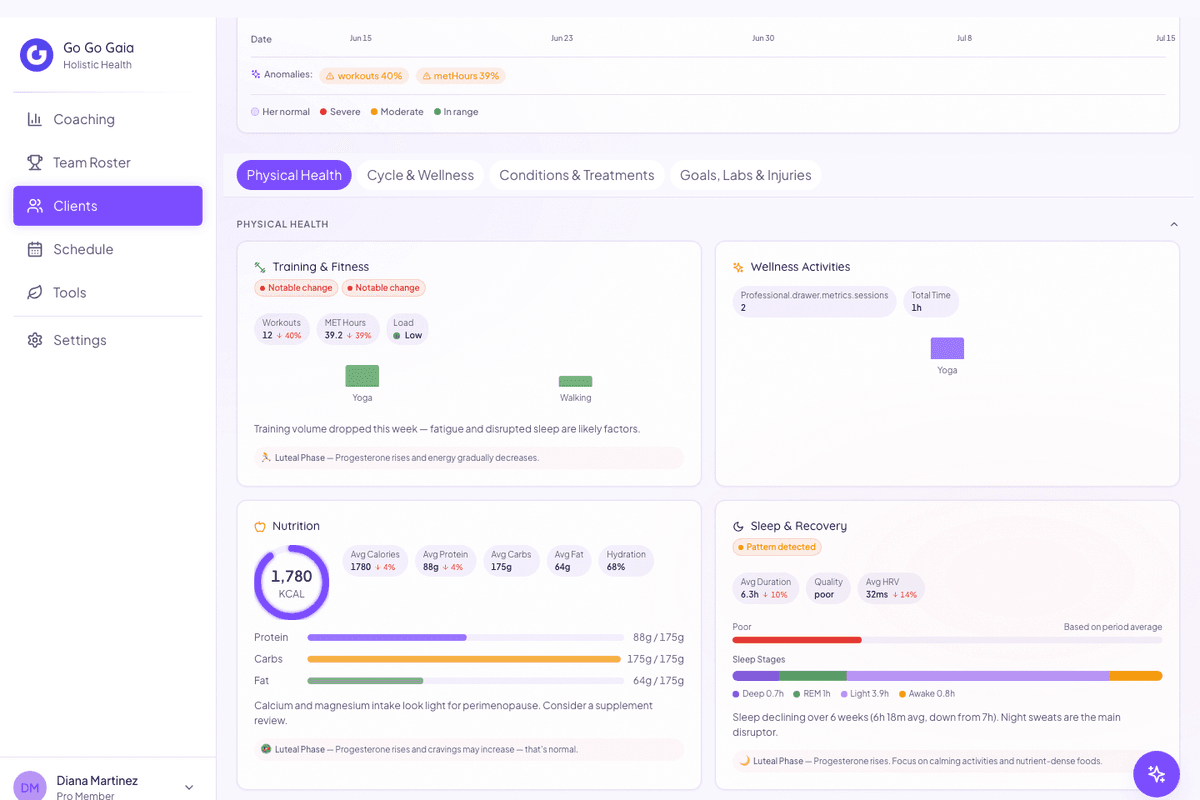
The alternative some coaches use is a consent-based portal where the client shares cycle, sleep, and symptom data once, through her own account, rather than being asked to recap it verbally every week. Nothing shows up on the coach's side until she opts in, she chooses what's included, and she can revoke access at any time without needing anyone's approval. It's the same information the conversation above is trying to get at, just without the repeated ask. If you want to see what that actually shows a coach, and what stays private no matter what, this guide covers exactly what a client-portal connection looks like from both sides. Our own coaching guide on working with a client's cycle in your programming covers the practical adjustments piece in more detail.
Frequently Asked Questions
Should I ask every female client about her cycle in the intake form?
Make it optional, not a required field. A blanket question on every intake form can feel like a checkbox exercise rather than a real conversation, and some clients will simply be uncomfortable answering it before they know and trust you. A better approach is to mention that you're open to factoring in cycle-related patterns if it's ever relevant to her training, and let her bring it up when she's ready.
What if a client tells me about a symptom I don't know how to handle?
Listen, adjust what's within your scope (the session plan, the load, the exercise selection), and if it sounds like something outside general training guidance, say so plainly and suggest she bring it up with her doctor. You don't need to diagnose what's going on or guess at a cause. Referring her to a clinician is the standard both NASM and ACE set for certified professionals, not a judgment call you have to make alone.
Is it different for male coaches?
Research on elite athletes found comfort discussing the cycle varies by coach, and some athletes reported being less comfortable raising it with male coaches specifically.1 That doesn't mean male coaches should avoid the topic. It means being extra deliberate about privacy, tone, and giving the client full control over whether and how much she shares, so the conversation doesn't feel like an imposition.
Do I need to know exactly what phase a client is in to adjust her training?
No. Phase alone is a weak predictor of how any individual client will feel or perform on a given day. What's more useful is what she's actually reporting: energy, sleep, and symptoms in real time. Cycle phase can be one piece of context, but it shouldn't replace asking how she's actually doing.
What should I never ask a client about her cycle?
Skip anything that reaches into medical history, diagnosis, fertility plans, or contraceptive choices. Those are between her and her doctor. Stick to what's relevant to training: how she's feeling, what's changed, and whether anything needs adjusting this week.
How often should I check in about it?
Less often than you'd think, and only when it's useful. Asking a client to recap her cycle and symptoms in every single check-in gets tiring for both of you. A consent-based portal where she shares the relevant data once, and updates it as she chooses, cuts down on that repeated ask while still giving you the context you need.
Related Articles
- What the Research Actually Says About Training Around the Menstrual Cycle: A Coach's Guide
- Can My Trainer See My Cycle Data? How Sharing Actually Works
- Coaching Clients Around Their Cycle
References
- Brown N, Knight CJ, Forrest LJ. Elite female athletes' experiences and perceptions of the menstrual cycle on training and sport performance. Scandinavian Journal of Medicine & Science in Sports. 2021;31(1):52-69. doi.org/10.1111/sms.13818
- Clarke A, Govus A, Donaldson A. What male coaches want to know about the menstrual cycle in women's team sports: Performance, health, and communication. International Journal of Sports Science & Coaching. 2021;16(3):544-553. doi.org/10.1177/1747954121989237
- Höök M, Bergström M, Sæther SA, McGawley K. "Do Elite Sport First, Get Your Period Back Later." Are Barriers to Communication Hindering Female Athletes? International Journal of Environmental Research and Public Health. 2021;18(22):12075. doi.org/10.3390/ijerph182212075
- Larsen B, Morris K, Quinn K, Osborne M, Minahan C. Practice does not make perfect: A brief view of athletes' knowledge on the menstrual cycle and oral contraceptives. Journal of Science and Medicine in Sport. 2020;23(8):690-694. doi.org/10.1016/j.jsams.2020.02.003
- Bruinvels G, Goldsmith E, Blagrove R, Simpkin A, Lewis N, et al. Prevalence and frequency of menstrual cycle symptoms are associated with availability to train and compete: a study of 6812 exercising women recruited using the Strava exercise app. British Journal of Sports Medicine. 2021;55(8):438-443. doi.org/10.1136/bjsports-2020-102792
- Solli GS, Sandbakk SB, Noordhof DA, Ihalainen JK, Sandbakk Ø. Changes in Self-Reported Physical Fitness, Performance, and Side Effects Across the Phases of the Menstrual Cycle Among Competitive Endurance Athletes. International Journal of Sports Physiology and Performance. 2020;15(9):1324-1333. doi.org/10.1123/ijspp.2019-0616
- Verhagen E, Ferrer E, Antero JS, Bahtijarevic Z, Barlow A, Bolling C, et al. UEFA consensus statement on menstrual cycle tracking in women's football. BMJ Open Sport & Exercise Medicine. 2025;11(3):e002769. doi.org/10.1136/bmjsem-2025-002769
- NASM (National Academy of Sports Medicine). NASM Code of Professional Conduct. nasm.org
- ACE (American Council on Exercise). ACE Certified Personal Trainer Manual, Chapter 1: Role and Scope of Practice for the Personal Trainer. acefitness.org
- ACE (American Council on Exercise). Navigating Boundaries: Certified Health Coaches and the Importance of Respecting Scope of Practice. ACE Certified, March 2024. acefitness.org
Sourced from peer-reviewed research and official scope-of-practice guidance from NASM and ACE. Every citation above is checked to confirm it resolves to a real source and supports the sentence it's attached to. Last reviewed September 2026.