Track Skin and Cycle Together: Best App 2026
You break out in the same spot, the same week, almost every month. Or you're not sure it's every month, because you've never actually written it down. This guide covers what a skin log can (and can't) tell you, 5 apps for tracking skin alongside your cycle, and exactly what to log so a real pattern shows up instead of a guess.
Full Transparency
This guide is published by Holland Neurotech Inc., the company behind Go Go Gaia. Go Go Gaia is one of the five apps compared here. We included it because we think it's a strong option for this use case, and we've been honest about its limitations too. Every app on this list does something well, and the right one depends on how you actually want to log.
Quick Answer: Which App Should You Use?
No app was built specifically to prove or disprove a skin-cycle connection, so the real question is which tracker fits how you want to log. Here are the picks by use case:
- For a dedicated skin photo diary: TroveSkin. Built around before-and-after photos and skin condition tracking
- For deep multi-factor correlation: Bearable. The strongest correlation tooling on this list, skin included
- For the lightest cycle-first option: Clue. A clean, science-first cycle tracker with skin-related tags
- For a treatment-connected skin plan: MDacne. Pairs a skin log with a dermatology-adjacent treatment service, not a pure tracking tool
- For skin, cycle, food, and sleep in one place: Go Go Gaia. Custom symptom logs like "breakout" connected to cycle phase, food, and sleep
How We Picked These Apps
We shortlisted the 5 apps below from what people actually use to log skin changes and connect them to their cycle, and compared them on the criteria that matter most here: how skin gets logged (photo, rating, or tag), whether logs connect to cycle phase, how fast a daily entry is, and whether the app is a pure tracking tool or tied to a treatment service. Pricing was re-verified on the App Store in July 2026, and we read each app's current privacy policy rather than relying on its marketing pages.
Full disclosure: this site is published by Holland Neurotech Inc., the maker of Go Go Gaia. The list isn't ranked. Each app is presented as the fit for a specific need, we include our own app only where it genuinely belongs, and we say plainly when a competitor is the better choice.

Medical Disclaimer
This article is for educational and informational purposes only and does not constitute medical advice. It does not recommend any skincare routine, ingredient, or product, and it can't tell you what's causing your breakouts or whether they qualify as "hormonal acne." Tracking apps record patterns. They don't diagnose or treat skin conditions. Always talk with a dermatologist or other qualified healthcare provider about your skin, and bring your tracked data to that conversation rather than trying to interpret it yourself. Individual experiences vary, and what one person's skin does is not a guide for what yours will do.
What We Know About Skin and the Menstrual Cycle
Breakouts that cluster around certain points in the cycle are a real, commonly reported pattern, not something you're imagining. The American Academy of Dermatology describes fluctuating hormones, including the shifts around menstruation, as one recognized contributor to adult acne, alongside genetics, stress, and other factors[1].
The general idea is that oil (sebum) production in the skin responds to hormone levels, and those levels shift across the cycle. The luteal phase, roughly the two weeks before a period, is when many people report more breakouts. But "many people" isn't "everyone," and the timing, severity, and location can vary a lot from person to person. Cleveland Clinic lists changing hormone levels, including the shifts around your period, among the recognized causes of hormonal acne[2].
What none of this tells you is whether it's happening to you, or when. That's the gap a skin log fills. Instead of "I feel like I break out before my period," a few tracked cycles can show you whether that's actually true, and which week it tends to happen.
One more thing worth saying plainly: this article isn't going to tell you what causes your specific breakouts or what to do about them. That's outside the scope of a tracking guide, and honestly outside the scope of anything short of a dermatologist looking at your skin. What we can help with is the observation part.
How We Compared These Apps
We compared each app on its App Store listing, published pricing, privacy policy, and recent user reviews, all checked in July 2026. We did not run a clinical study, and we haven't hands-on tested every feature of every app. And full disclosure: we make Go Go Gaia, one of the five apps here.
For this use case, we weighted four things most heavily: how skin gets logged (a quick rating, a tag, or a photo), whether the app connects that log to your cycle automatically, how much daily effort logging takes, and whether the app is a neutral tracking tool or bundled with a treatment or product service.
The 5 Apps Compared
These five apps split into three groups: a dedicated skin diary (TroveSkin), symptom-first correlation trackers (Bearable, Go Go Gaia), a cycle-first tracker with skin tags (Clue), and a treatment-connected app (MDacne). None of them was built purely to answer "does my skin follow my cycle." The right pick depends on whether photo logging, correlation depth, or a lighter cycle-first approach matters most to you.
For a Dedicated Skin Photo Diary: TroveSkin
Best if you want: An app built specifically around tracking your skin over time with photos, not a general symptom tracker with skin as an afterthought.
Key Features
- Guided photo logging with consistent lighting and angle prompts
- Timeline view to compare skin over weeks or months
- Notes field for context alongside each photo
- Some skin-diary apps in this category (TroveSkin and similar tools like Skin Bliss) also let you log products used, for your own reference
Strengths
- Photos capture what memory tends to smooth over. A rough week can feel worse in hindsight, or get forgotten entirely, and a photo timeline doesn't have that problem
- Purpose-built interface for skin specifically, so logging feels quick and natural
- Private photo storage is generally the norm for apps in this category, though it's worth checking the specific app's current privacy policy
Limitations
- No cycle tracking. You'd log your period elsewhere and compare dates by hand, or pick an app in this category that adds a basic cycle log
- No correlation tooling. Comparing photos across your own cycle weeks is manual work
- Photo logging takes more time than a quick tap or rating, which can be a barrier to consistency
Who Should Choose This
- You want a visual record of your skin over time more than a numeric log
- You're comfortable tracking your cycle in a separate app and comparing dates yourself
- You want a tool built specifically for skin, not a general symptom tracker
Pricing
Free tiers with optional premium upgrades are typical for apps in this category. Check the current listing for TroveSkin or Skin Bliss on the App Store for exact current pricing, as it changes.
For Deep Multi-Factor Correlation: Bearable
Best if you want: The most thorough symptom-correlation tooling available, with skin as one custom factor among many, including your cycle.
Key Features
- Fully custom symptoms and factors. Rate breakouts, redness, or oiliness on scales you define
- "Impacts" view that correlates your factors with your outcomes over time
- Optional period tracking module
- Sleep, food, and activity logging alongside symptoms
Strengths
- The correlation engine is genuinely the strongest on this list. If you want to see how skin relates to cycle day, sleep, and stress at the same time, Bearable was built for exactly that
- Generous free tier and strong app store ratings on iOS
- GDPR-compliant and states it doesn't sell data
- Cross-platform (iOS and Android)
Limitations
- Setup takes real time. There are a lot of options to configure before your first log
- Cycle tracking is a module, not the core. No phase predictions or cycle-specific insights beyond what you set up
- No photo logging for skin specifically, only ratings and notes
Who Should Choose This
- You're already tracking other symptoms and want skin folded into the same log
- Correlation depth matters more to you than cycle-first design or photos
- You need Android support
Pricing
Free (generous tier), Premium ~$34.99/year or ~$6.99/month. Available on iOS and Android.
For the Lightest Cycle-First Option: Clue
Best if you want: A clean, science-first cycle tracker where you add skin as one tag among your other cycle data.
Key Features
- Cycle tracking with phase information and predictions
- Built-in skin tag, plus custom tags for anything more specific
- 30+ built-in tracking categories including mood, energy, and sleep
- Science-backed content reviewed by researchers
- GDPR-compliant (Berlin-based, EU privacy standards)
Strengths
- Clue is based in Germany and operates under EU GDPR rules, with a strong track record on data practices
- Clean, minimal interface that's quick to log in
- Cross-platform (iOS and Android)
- Skin data sits right next to full cycle context by default
Limitations
- Skin tracking is a tag, not a dedicated feature. No photos, no severity scale beyond what you build with custom tags
- Pattern analysis is limited. You'll mostly spot trends by scrolling back through past cycles yourself
- Free users see regular prompts to upgrade to Clue Plus
Who Should Choose This
- You want a cycle tracker first and a skin log second
- Privacy is a top priority for you
- You're happy to review your own data for patterns rather than getting computed insights
Pricing
Free (with upgrade prompts), Clue Plus ~$39.99/year. Available on iOS and Android.
Worth Knowing: MDacne (A Treatment Service, Not a Pure Tracker)
Best if you want: A skin log connected to an actual treatment plan and dermatology-adjacent service, rather than tracking on its own.
MDacne pairs photo check-ins and skin logging with a subscription treatment service, including personalized product recommendations and, depending on the plan, consultations. That makes it a fundamentally different kind of app from the others on this list. It's treatment-oriented, not a neutral tracking tool, so we're covering it briefly rather than as a full profile.
Key Features
- Photo-based skin check-ins over time
- Personalized treatment and product recommendations tied to a subscription
- Progress tracking against your treatment plan
Who Should Consider This
- You're looking for a treatment service, not just an observation tool. That's a separate decision from tracking, and one to make with a healthcare provider
- You want your skin log connected to a specific product regimen you're already following
If what you actually want is a simple, honest record of your own skin-cycle pattern with no product or treatment attached, TroveSkin, Clue, Bearable, or Go Go Gaia fit that goal more directly.
For Skin, Cycle, Food, and Sleep in One Place: Go Go Gaia
Best if you want: A custom "breakout" log connected automatically to your cycle phase, food, and sleep, without juggling a separate skin app and period app.
Key Features
- Custom symptom logs. Create "breakout," "oily skin," or "clear skin" and rate it in a couple of taps
- Correlation insights that connect those logs to cycle phase, food, and sleep, drawn from your own data
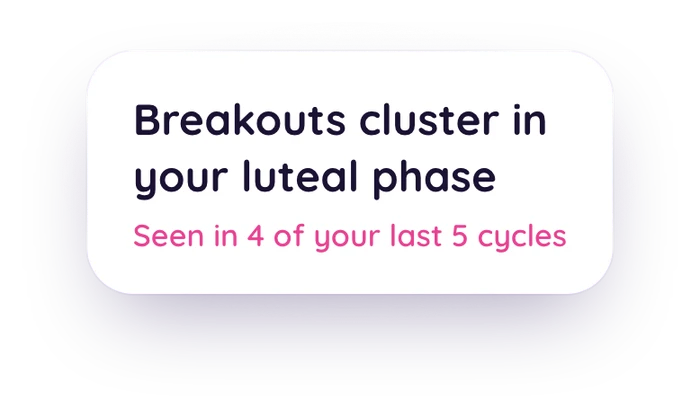
- Health Clues: save a hypothesis like "my skin gets worse the week before my period" and the app checks it against your logged data over time
- Cycle tracking with phase context built in
- Food, sleep, and habit logging in the same app, so nothing needs to be lined up by hand
Strengths
- Skin, cycle, food, sleep, and habits live in one app, so the data streams you'd want to compare are already side by side
- Surfaces patterns like "breakouts are more frequent in the week before my period" instead of leaving you to scroll back through old entries
- No ads, no data selling
Limitations
- iOS only. No Android version yet
- No dedicated photo-comparison tool for skin the way TroveSkin has. Ratings and notes, not a photo timeline
- Newer app with a smaller community than Clue or Bearable
- Some advanced features, including the full AI assistant, require premium ($9.99/month or $49.99/year)
Who Should Choose This
- You want skin logged in the same app as your cycle, food, and sleep, with the pattern-finding done for you
- You're on iPhone and prefer one app over juggling two or three
- You'd rather rate breakouts quickly than maintain a photo diary
Pricing
Free (most features), Premium $9.99/month or $49.99/year for full AI insights and advanced correlations. Available on the iOS App Store.
Feature Comparison Table
Quick read of the table: TroveSkin wins on photo logging, Bearable and Go Go Gaia both connect skin to your cycle and other factors automatically, Clue is the lightest cycle-first option, and MDacne is really a treatment service with tracking attached. Here's the full picture (✅ full support, ⚠️ partial, 🔒 premium only, ❌ not available):
| Feature | TroveSkin | Bearable | Clue | MDacne | Go Go Gaia |
|---|---|---|---|---|---|
| Cycle & phase tracking | ❌ None | ⚠️ Optional module | ✅ Core focus | ❌ None | ✅ With phase context |
| Photo skin log | ✅ Core focus | ❌ None | ❌ None | ✅ Core focus | ⚠️ Notes, no photo timeline |
| Custom skin ratings or tags | ⚠️ Notes field | ✅ Fully custom | ✅ Built-in + custom tags | ⚠️ Structured check-in | ✅ Custom logs |
| Skin linked to cycle phase | ❌ Manual comparison | ⚠️ If module on | ⚠️ View by cycle | ❌ Not applicable | ✅ Core design |
| Correlation insights | ❌ None | ✅ "Impacts" view | ❌ Manual review | ❌ None | ✅ Multi-factor |
| Food & sleep logging | ❌ None | ✅ Included | ⚠️ Basic sleep only | ❌ None | ✅ Included |
| Treatment or product service | ❌ Tracking only | ❌ Tracking only | ❌ Tracking only | ✅ Core focus | ❌ Tracking only |
| Free tier quality | ⚠️ Varies by app | ✅ Generous | ⚠️ Upgrade prompts | 🔒 Subscription-based | ✅ Generous |
| Platforms | iOS + Android | iOS + Android | iOS + Android | iOS + Android | iOS only |
| Best for | Photo skin diary | Deep correlation | Light cycle-first | Treatment plan | Skin + cycle + food + sleep |
When Another App Is the Better Choice
Go Go Gaia isn't the right pick for everyone reading this, and a few of these apps win outright for specific situations. Here's where we'd honestly point you elsewhere, in two or three sentences each.
Choose TroveSkin if you want a visual timeline more than numbers
If you think in pictures and want to scroll back through weeks of photos rather than reviewing ratings, a dedicated skin diary does that better than any general symptom tracker. You'll log your cycle separately and compare dates yourself, but for a purely visual record, this category of app is built for exactly that.
Choose Bearable if skin is one symptom among several you're tracking
If you're already logging other symptoms like migraines, fatigue, or mood, and want skin folded into that same correlation engine, Bearable's "Impacts" view is the strongest analysis tool on this list. It's also on Android, which Go Go Gaia isn't.
Choose Clue if privacy and simplicity matter most
If you mostly want a clean, well-established period tracker and just need a skin tag on top, Clue does that with minimal fuss and a genuinely strong privacy record. You'll review patterns yourself rather than getting computed insights, and for some people that's plenty.
Consider MDacne if you're looking for a treatment plan, not just tracking
If your goal is an actual treatment regimen rather than observation, MDacne's subscription service pairs a skin log with product recommendations. That's a different kind of decision than choosing a tracking app, and one worth making alongside a healthcare provider.
What to Log to See Your Own Pattern
Log three things daily or every other day: a breakout rating, roughly where it shows up, and your period dates. Keep it up for 2 to 3 full cycles. That's the whole method. Here's how to make it stick:
- Make the rating dead simple. A 1-to-5 scale ("clear" to "a lot of breakouts") takes a few seconds. The longer a daily log takes, the less likely it is to survive past a few weeks, so keep it to a few seconds.
- Note general location, not every detail. "Chin and jawline" or "forehead" is plenty. You're looking for a repeating pattern, not building a dermatology chart.
- Add a weekly photo if you can manage it. Memory tends to smooth things over. A photo taken in similar light, once a week, catches what a rating alone might miss.
- Track the boring stuff too. Stress, sleep, and travel muddy the picture if you ignore them. A rough skin week during finals or after a bad night's sleep isn't necessarily a cycle pattern.
- Anchor everything to cycle day. The pattern you're hunting is "the same cycle week, repeating." After 2 to 3 cycles, compare your pre-period week across months and look for repeats.
- Bring the record to a dermatologist if you want to talk it through. "My skin flares the week before my period, and here's three cycles of data" is a much more useful starting point than "I feel like my skin gets worse sometimes." What to do with that pattern is a conversation for their office, not for an app.
A tracking app handles two of these steps for you: a quick log like Go Go Gaia's custom symptoms keeps the friction low, and correlation insights do the cycle-day comparison automatically, surfacing things like whether your "breakout" logs cluster in the second half of your cycle. A dedicated photo diary like TroveSkin does the visual side better than any general tracker. Either approach works. The one that matters is the one you'll actually keep up for 2 to 3 months.
Privacy Considerations
Skin logs, especially photo-based ones, are sensitive by nature. Before choosing an app, it's worth checking a few things directly in the app's current privacy policy rather than assuming: whether photos are stored locally or in the cloud, whether the company sells or shares data with advertisers, and whether the app is tied to a treatment or product service that might use your data for marketing.
Clue has a long-standing reputation as a privacy-forward cycle app, built under EU data protection standards. Bearable states it doesn't sell data and is GDPR-compliant. For dedicated skin-diary and treatment-connected apps, privacy practices vary more by provider, so it's worth reading the specific app's policy rather than assuming.
Frequently Asked Questions
The short version: breakouts that follow a cycle pattern are a commonly reported experience, no single app was built purely to prove or track that connection, and 2 to 3 tracked cycles is what it takes to see your own pattern. The details:
Why do breakouts show up around the same time every cycle?
Hormone levels shift across the menstrual cycle, and oil production in the skin appears to shift along with them. Many people notice more breakouts in the days before their period. The leading explanation is that skin oil production responds to the hormone shifts across the cycle, though it isn't the only factor. A skin log is the clearest way to see whether that pattern actually holds for you, cycle after cycle.
Is there an app just for tracking skin and your period?
A few options exist. Dedicated skin-diary apps like TroveSkin and Skin Bliss focus on photo logs and skin condition tracking. Cycle apps like Clue support skin-related tags alongside period tracking. Go Go Gaia and Bearable let you log skin as a custom symptom next to your cycle, sleep, and other factors in one place.
What should I log to see my own skin-cycle pattern?
Keep it simple: a breakout rating or count, roughly where on your face or body, and your period dates. A weekly photo helps too, if the app supports it. The goal is a consistent, low-effort log, not a detailed diary.
How many cycles does it take before a pattern shows up?
Plan on 2 to 3 full cycles. Skin reacts to a lot of things besides hormones, including stress, sleep, weather, and travel, so one cycle isn't enough to tell a real pattern from a coincidence. After 2 to 3 cycles, compare the same cycle week across months.
Can a tracking app tell me if I have hormonal acne?
A tracking app can't diagnose hormonal acne or anything else. It can show you whether your breakouts follow a repeating pattern tied to your cycle. That's a conversation for a dermatologist, and a dated log of what you've observed is exactly the kind of information that conversation benefits from.
Should I use photos or just written ratings to track my skin?
Either works, and some people do both. Photos are useful because memory tends to smooth things over: a bad week can feel worse in hindsight, or you might forget a mild one entirely. A quick 1-to-5 rating is faster and easier to keep up daily. If you can only manage one, pick the one you'll actually stick with for 2 to 3 months.
Does what I eat affect my skin around my period?
Some people report a connection between diet and breakouts, but the research is mixed and highly individual. If you're curious, logging meals alongside your skin and cycle can show you whether a pattern exists for you specifically. That's an observation, not a rule to follow, and it's worth discussing with a doctor or dermatologist before changing your diet.
Final Thoughts
If your skin has a monthly rhythm, you're probably not imagining it, and a lot of people report the same thing. What that rhythm actually looks like for you is specific enough that no article can spell it out. Two to three tracked cycles can.
Pick the app that matches how you actually want to log: TroveSkin or Skin Bliss for a photo-first diary, Bearable for deep correlation across many symptoms, Clue for the lightest cycle-first option, MDacne if you want a treatment plan attached, and Go Go Gaia if you want skin, cycle, food, and sleep connected automatically in one place.
Still deciding? Just pick one and log for two cycles. See what you find.
Skin Patterns Need 2 to 3 Cycles of Data to Show Up
That's the article's whole method in one line. A quick log takes a few seconds a day, and by the end of your second cycle you can compare the same pre-period week across months and see whether your breakouts actually repeat.
Set up "breakout" as a custom symptom log. The correlation insights do the cycle-day math for you.